
Tours reopen for the Tri-Cities excavation of Ice Age mammoth bones
Public tours are back at the Coyote Canyon Mammoth Site near Kennewick and digging to unearth the bones of the Ice Age creature has resumed after a quiet year due to the COVID-19 pandemic.
If you’d like a first-hand look at the work, registration has opened online for public tours on one Saturday morning a month at bit.ly/McBonesTour.
Participants will be emailed directions to the tour site, which is at an undisclosed location to prevent vandalism, and instructions for participating.
The initial discovery of mammoth bones at the site was made in 1999, but it remained secret until 2008 when MCBONES — the Mid-Columbia Basin Old Natural Educational Sciences Research Center Foundation — was established as an educational non-profit.
Thousands of school children and families have since visited the site.
Coyote Canyon is the resting place of a 17,500-year-old Columbian Mammoth.
It lived during the Ice Age floods, which could have been from as long as 19,000 years ago to as recently as 14,000 years ago.
Flood water backed up as it hit the narrow Wallula Gap to cover what is now the Tri-Cities. The dig site is at an elevation of about 1,060 feet, and floods may have been deep enough to reach the area about seven times.
The mammoth could have been drowned in the flood, and then the carcass could have been deposited on the hillside as waters receded. The bones have been found relatively intact — the ribs somewhat jumbled, for example, but not scattered over a wide area.
The mammoth appears to be a male, because bone growth plates take longer to fuse in males. He likely was about 40 years old when it died with a front leg growth plate still unfused.
The animal was large, likely standing 10 to 13 feet tall at the shoulder, making it bigger than modern day elephants.
As the bones are carefully excavated, the dirt at the dig site is screened.
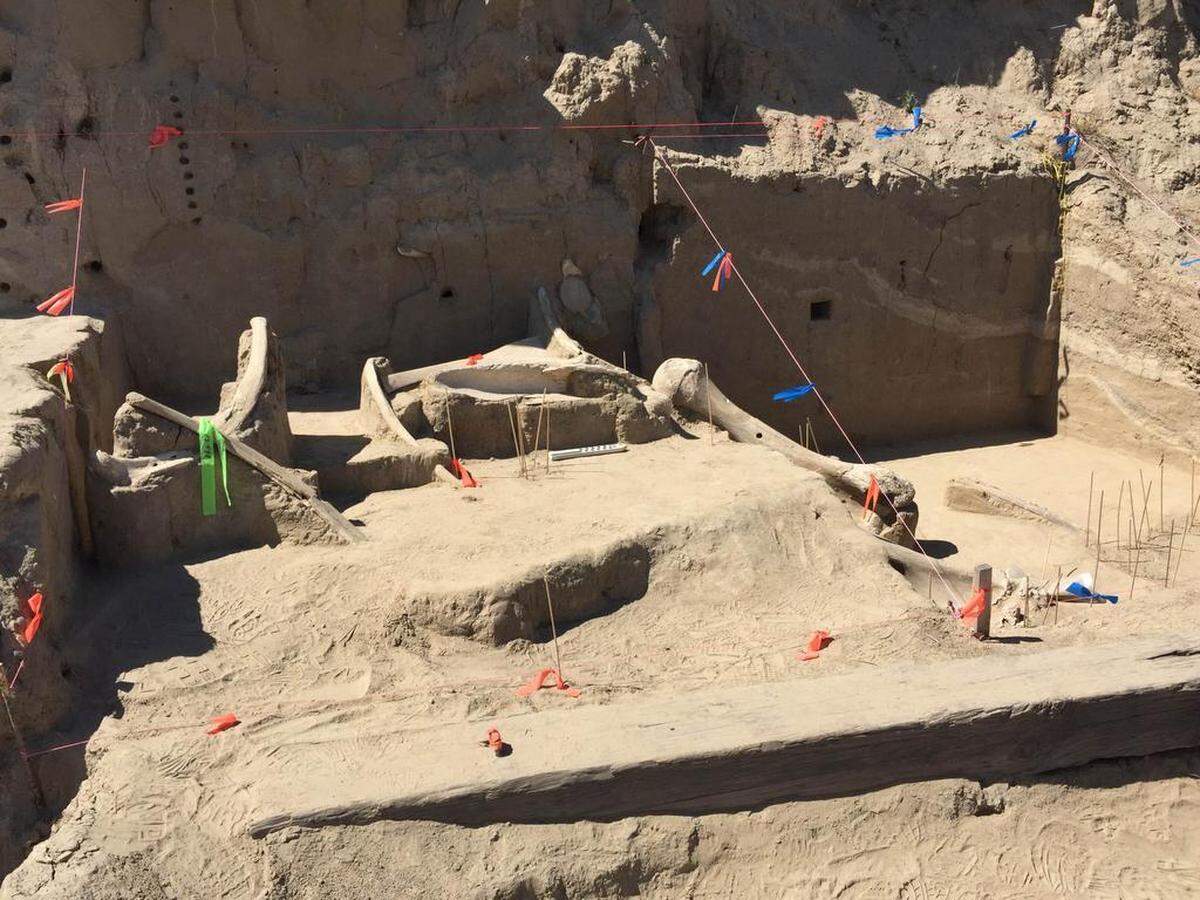
Any evidence is found — such as the remnants of snakes, mollusks, lizards and ground squirrels — it is cataloged.
Findings will be used to understand the Mid-Columbia’s climate through the centuries, based on the species that lived here.
Some of that microbiology work was done in 2020, but all digging stopped due to COVID-19.
“Nature had its way. We had a good bit of erosion,” said Gary Kleinknecht, the site’s education and outreach director.
Erosion left a rib and a vertebrae from the mid to upper back exposed and sticking out of the vertical dig wall. They will be recovered next.
MCBONES also schedules group and school tours.
.JPG "SHi_j0181(25).JPG")
For more information, including what to expect on a tour at the undeveloped dig site, go to mcbones.org and click on the “CCMS Tours” tab.
Tour participants are encouraged to be vaccinated against COVID-19, to wear masks indoors and to practice social distancing. Closed-toed shoes are required.
There is no charge for the tours, but donations are welcome.
MCBONES also is looking for volunteers who can commit to working two weekends each month from March through October.
Internships are available for high school and college students. Email gary.kleinknecht@charter.net for more information.