
Meet the Tri-Citian who ran the 350-mile Iditarod with no dogs — pulling a 50-lb. sled
What makes a person want to run 350 miles through snowy, sub-freezing temperatures, in icy conditions, all the while pulling a 50-pound sled through the dark in Alaska?
Burbank’s Brandon Lott says it’s about the challenge.
“I love the environment. I love being out there,” he said. “It’s so beautiful. It’s so awesome to be in the mountains, in Alaska, in the wilderness.”
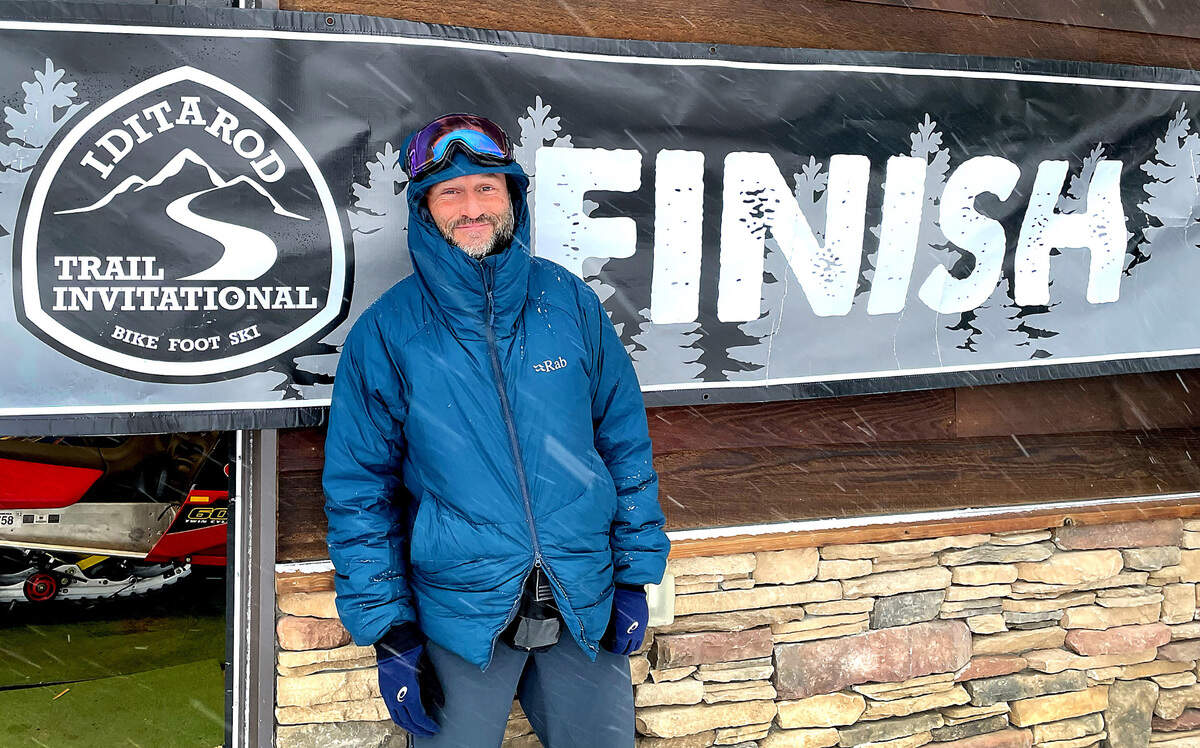
Lott, 48, recently completed the Iditarod Trail Invitational 350 (ITI 350). This Iditarod is not the race with the dogs and sleds.
Oh no.
Competitors in this event normally follow that same trail the dogs use, leaving the Anchorage area and finishing in the village of McGrath.
But in this time of COVID, race officials created a different course, one that would avoid traveling near the villages of Nikolai and McGrath.
This year competitors started Feb. 28 at a place outside Anchorage called Knik Lake, traveled 175 miles northwest to an outpost called Rohn, then doubled back to finish near Anchorage at a spot next to Big Lake.
There are three classes of competitors — bicycle riders using fat tires, skiers and the “foot men” division.
Lott was on foot.
Twenty-one entered and about half finished.
After 10 days, most of it in pain, he arrived 32nd among all the divisions.
But he did it.
Running career beginning
Lott is an ultra marathoner, and he says there are less than a dozen who compete at that level in the Tri-Cities area.
He and his wife Marilyn started the local Badger Mountain Challenge in 2011.
“I’ve run about 93 ultra marathons,” he said.
Not bad for a guy who thought running was silly.
“Before I started running, I thought running was the dumbest thing in the world,” Lott admits.
But all it took was $400 to get him out on the streets and trails. It was 2006, and he was 35.
“I had a sedentary life,” he said. “I’d sit on the couch all the time. I was kind of a bum. But inside of myself, I knew I was looking for something to do. I wanted something.”
Marilyn’s family had started its own Biggest Loser contest.
“They had $400 in the pot,” Lott said. “So I started running to lose weight. I felt I had 30 to 40 pounds to lose. I found out if you keep running, you can lose it. I won the pot and I’ve been keeping the weight off since.”
He was 192 pounds before he started running. Now his 5-9 frame carries a healthy 155 pounds.
“Running gave me a whole new aspect on life. Now, I was a runner. I made new friends through running,” Lott said.
OK fine. Running gave him a new outlook on life. But wouldn’t a 5K or 10K suffice? Even one marathon?
“Marathons are just not quite the same challenge. I mean, they’re very challenging,” said Lott. “There a lot of competitors in a marathon, and you’re competing against the guy next to you.”
Lott’s first marathon was near Mt. Hood, and competitors ran on the Pacific Crest Trail.
“It was so cool,” he said. “So I wanted to find more marathons on a trail.”
What he found were 50K races. And he ran those.
Then he found the 100-mile races, and he was hooked. Any race over an official marathon distance — 26.22 miles — is considered an ultra marathon.
And in 100-mile races, “You meet a lot of interesting people.”
He had found his racing family.
Iditarod Trail Invitational 350
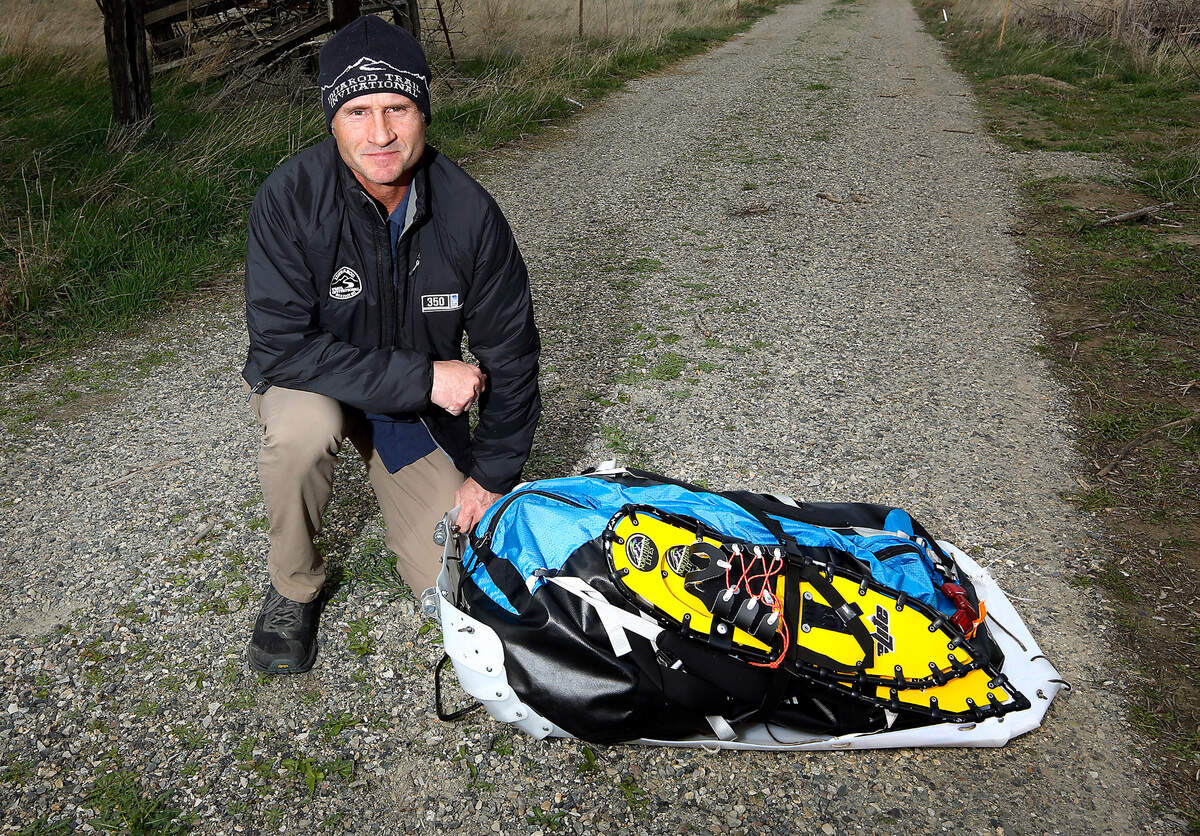
Lott had run the ITI 350 race before, in 2013 at the age of 40.
To qualify, he says, you have to finish a shorter (as in 100 miles) winter race. He had done that in 2011.
“And you have to finish (the ITI 350) race to qualify for the (ITI) 1,000-mile race,” he said.
Excuse me … The what? More on this further down the story.
The opportunity came up this year to run the ITI 350 again when he asked his brother-in-law, a marketing director for a charity called Sleep in Heavenly Peace, if his employers might be interested in sponsoring him while he helped raise awareness.
The charity makes bunk beds for children so they don’t have to sleep on the floor.
With Sleep in Heavenly Peace, fundraiser format RallyUp, as well as help from Runner’s Soul owner Scott Conrad, Lott was in for the 2021 race.
The first time he ran the race in 2013, Lott took 6 ½ days to complete the event.
“My plan this time was to do it in 5 to 7 days,” he said.
How do you train for a 350-mile race through wintry conditions?
To prepare for something like that, Lott might drag a tire hooked to a belt and pull it around for miles.
“Just running in general. It’s spending time on your feet. You go out for several hours at a time,” he said. “But something like a 100-mile race is more mental, because you’re running all day, then all night, then all day again. It’s like a whole new race again when the sun comes up on the second day. When it comes up, it revitalizes you.”
Lott was doing well at the beginning of the race, which started at 2 p.m. on Feb. 28. The first checkpoint was at Butterfly Lake, 25 miles away. He arrived that night at 10:30 p.m., stayed for 68 minutes to rest and eat, then was headed to checkpoint 2, at Yetna, 30 miles away.
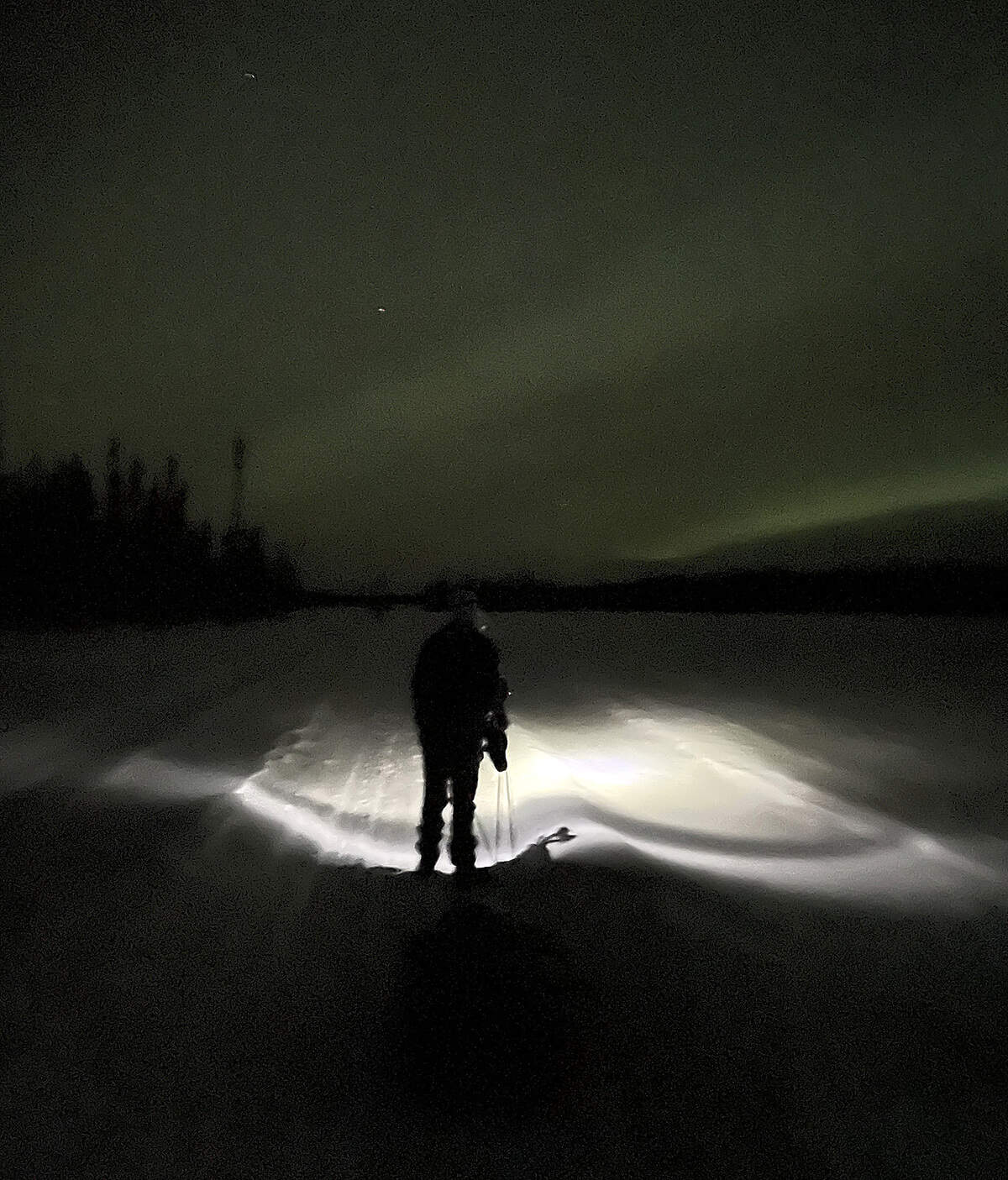
He ran through the night, using his head lamp, and arrived on Monday, March 1, at 4:45 p.m.
“When I started, the first three days I was on schedule. I was running at the front of the pack,” Lott said.
And then … It happened.
On the third day, Lott was out in the countryside when he crossed a wooden bridge over a creek and hit an icy patch. He fell, and injured his back.
Nothing was broken. He had likely pulled some muscles.
“It was the beginning of the end for me,” Lott admitted. “I had really tight knots.”
But something inside a competitor such as Lott makes them reach deep and find a way to keep going.
In Lott’s case, he was stopping every 5 to 10 minutes to lay down to let the back relax or stretch himself backwards.
His pace understandably slowed. But he kept going.
The mental part
It takes a lot of strength, both physically and mentally, to complete a 350-mile race.
Suffering a back injury just adds to your problems.
“There’s just a wide range of environments,” Lott said. “Sometimes you’re running with somebody. Sometimes you’re trying to catch somebody. Sometimes you’re trying to put some distance on someone behind you.
“Sometimes … You’re just out there by yourself.”
He didn’t sleep the first night or the last night of the race. And when he did sleep, at most it was just for a couple of hours a night.
But you do have yourself, and you’re always thinking.
“You definitely go through all types of scenarios,” he said. “There is a constant systems check. What’s working. What’s not. What do you need? What do you need to eat? It’s a 24-7 systems check. How far do I have to go to the next aid station? What about running in the dark?
“What do I eat when I get to that aid station? How long of a stay should I do? Do I take a nap, or to I turn and burn? Some checkpoints have food for you. Maybe some hot water.”
You have to think, he says, about what you need to do in advance.
“You can sit down sometimes and just be in a daze.”
He ran across no actual wildlife. But he did spot wolf tracks on both sides of the trails.
And a ton of moose tracks.
“Moose are really aggressive. They’ll stand their ground and trample you down,” said Lott.
Don’t forget about the 50-pound sled he has to pull.
“There was no required gear,” he said. “Each runner had different gear. Some people’s sleds weighed 70 pounds. Others had 35-pound sleds. Mine was 50.”
In that sled he had:
• Sleeping bag that can withstand minus-30 degree temperatures.
• Small stove.
• Little pot to melt snow so he could boil water.
• Bag of food and snacks.
• Clothes, which included a down jacket, down pants, a rain jacket, a smart wool for a base layer, and running pants.
• Just one — that’s right, just one — pair of running shoes.
• Three pairs of socks (although he admits he used just one the entire time).
Lott made sure to constantly check his feet for blisters, pre-taping them in the rough spots each checkpoint stop. And it was paramount to keeping them dry.
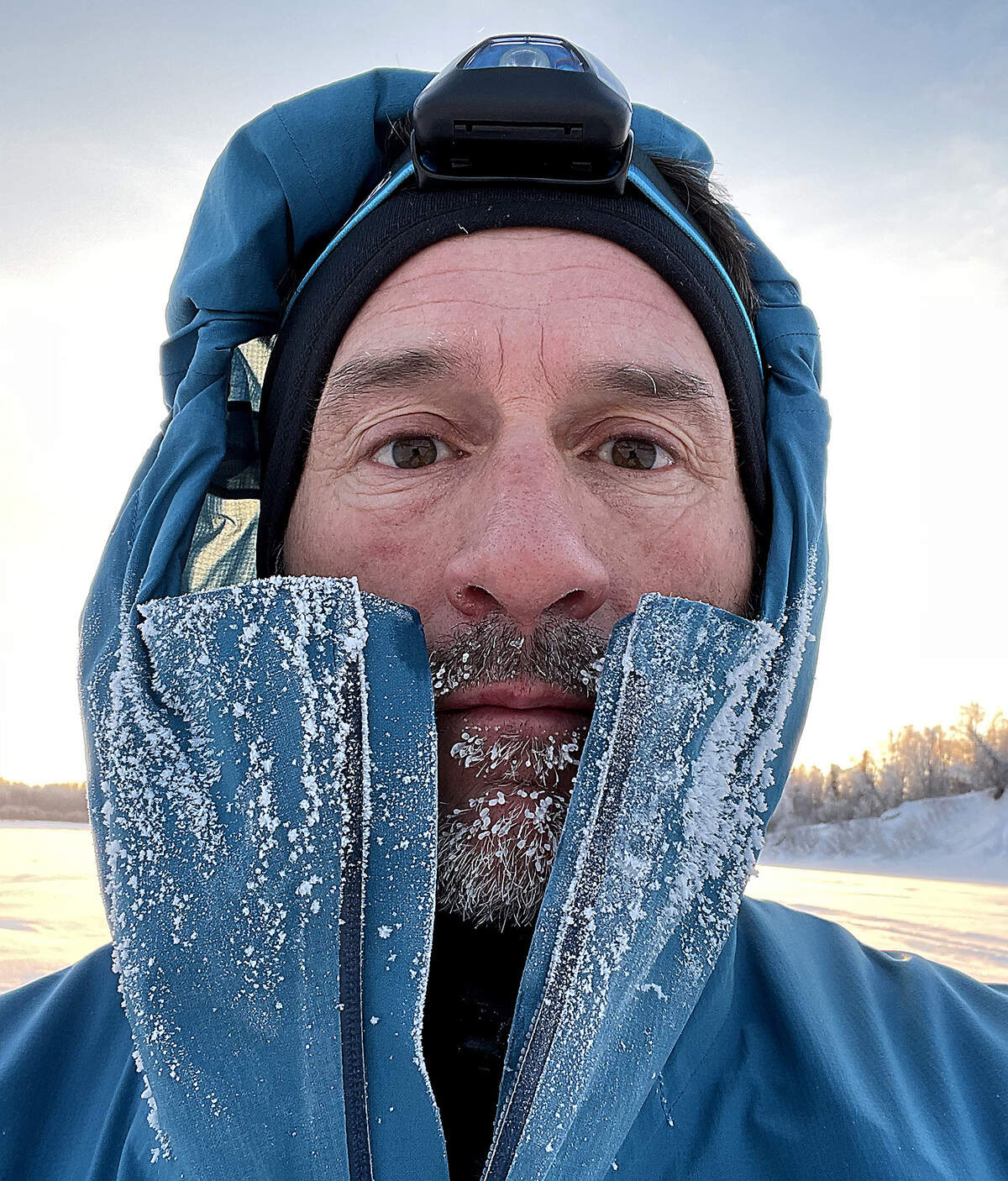
The other main battle was weather, which was constantly changing.
“The entire course was 100 percent snow,” Lott said. “It had frozen lakes and rivers. Places so icy you had to stay on a track of snow. But it was really slippery.”
There was freezing rain and sleet, and nice white, fluffy snow. The trails ranged from firm to sloshy.
And it always seemed windy.
Then there was the dark.
Final night
Perhaps the hardest part of the ITI 350 are the final two checkpoints and finish line.
It takes longer to get to them, so if you’re not already exhausted, you will be by the time you get to the end.
One check point takes 55 miles to get to; the next is 60 miles; then it’s 40 miles to the finish.
On the last night, in the darkness, Lott was lost and confused.
He couldn’t find the trail.
“I lost the trail for 2 hours,” Lott said. “I kept looking on my GPS for it.”
It was early in the morning, 2 a.m., and windy and hard to see.
But sometimes you need a little luck.
Marilyn Lott was back home, in bed, and wide awake. She couldn’t sleep.
So she opened her laptop up to see how Brandon was doing. It didn’t take her long to know something was wrong.
“She noticed I was going in circles,” Lott said. “So she texted me and asked me if I was OK?”
Lott responded: “I’m lost. I can’t find the course.”
From where Marilyn was, she could see on the computer that another competitor was nearby: skier Sunny Stroer.
“She told me, ‘There is another skier coming up behind you.’ It’s snowy. It’s dark. My wife says to walk directly north and you should run into her. So I do it. Suddenly, I see a head lamp in the distance.”
Lott yelled out, “Sunny, is that you? Are you on the course?”
Stroer was, and Lott was able to get back on track.
“Luckily, my wife was awake and was looking at the track. She realized I was confused,” said Lott.
During this time of confusion, Lott had lost his right glove. Never found it. It would cause him frostbite on his fingers, and only a few weeks after the race, he’s now starting to get tingling sensations back in his fingers.
Lott followed Stroer up a long hill that had just gotten 6 to 8 inches of fresh snow, as she pulled away on her skis and he labored to pull his sled, which he says was an anchor at that point.
As the sun rose on March 10, Lott approached the finish line — a large house at about the 5-mile mark next to the 9-mile long Big Lake.
“It was really windy on the lake,” Lott said. “Blowing snow drifts. The wind was blowing so hard. Barely any visibility. There was an icy road to run on.”
Lott finally got close, but he took a wrong turn.
“The race director and his wife saw me running around, and they were trying to help me find the finish line. I circled around and finally found it,” Lott said. “At the time, I wasn’t worried about the frostbite, and got to the finish line. They rushed me upstairs.”
It was 5:47 p.m., on Wednesday, March 10.
Total time for Lott from start to finish: 10 days, 3 hours, and 47 minutes.
What’s next?
After completing this race, Lott has qualified to run the ITI 1,000, which starts in Anchorage and finishes in Nome.
Competitors can complete it in 20 to 30 days.
“It depends on the conditions,” Lott said. “But after I finished the 350-mile race, my wife told me I couldn’t do the 1,000-mile race until all of (our four) kids are old enough and out of the house.”
He says he also has to get his mother — whom he works with at their Applegate Orchards in Burbank — to warm up to the idea.
Regardless, Lott is proud of what he’s done.
“There is a huge sense of self-accomplishment. That you’re able to do something like this. It helps a person realize that we can almost do anything.”
He is working on building a new house, and he wants to be done by Thanksgiving.
“(Marilyn) keeps on doubting me,” Lott said. “But compared to what I’ve been doing, this will be a piece of cake.”