
‘Epitome of the Tri-Cities.’ $7.7 million space exploration center for students begins
In a little over a year the LIGO Hanford Observatory near Richland expects to open a new center, where students and the public can learn about gravitational waves at the place where their existence was detected.
Ground has been broken to build the LIGO Exploration Center with 50 hands-on exhibits and other displays, including a gold-plated 2017 Nobel Prize in Physics.
The 2017 Nobel Price in Physics was awarded to three key members of the LIGO team for their work toward the historic detection of gravitational waves in 2015 at the Hanford Laser Interferometer Gravitational-wave Observatory and its twin observatory in Louisiana.
The observatories detected the ripples through time and space that reached the Earth 1.3 billion years after two black holes orbited each other and then collided.
Albert Einstein predicted the existence of gravitational waves nearly 100 years earlier and their detection confirmed his theory of relativity.
The Exploration Center, paid for with a $7.7 million grant from the state of Washington, is expected to open in January 2022, LIGO Hanford announced on Friday.
Some 24 years ago Fred Raab, now the associate director of operations for LIGO Laboratory, started inviting teachers out to the construction trailer of what would be the LIGO observatory for tours and discussions.
An education program developed that has brought 3,000 to 4,000 K-12 students to the observatory annually, in addition to sending LIGO scientists into Tri-Cities area classrooms.
“But with the growing interest in LIGO and its ongoing discoveries, we wanted to reach and inspire even more students of all ages,” said Amber Strunk, education and public outreach lead at the Hanford LIGO.
After LIGO announced its first detection of gravitational waves in February 2016, the number of schools wanting to schedule field trips to the observatory nearly doubled. Before the COVID pandemic, LIGO was having trouble accommodating all the requests.
Now students, teachers and families will come through the doors of the new center and learn not only about cutting-edge science, but about science, technology, engineering and math careers, said Michael Landry, head of LIGO Hanford.
Black hole building design
It is expected to be visited by up to 10,000 students each year, as well as other public visitors.
Terence L. Thornhill Architect of Pasco designed the center around the image of two black holes colliding, with one circular area at the entry and an overlapping circular area for the Rattlesnake Mountain viewing area.
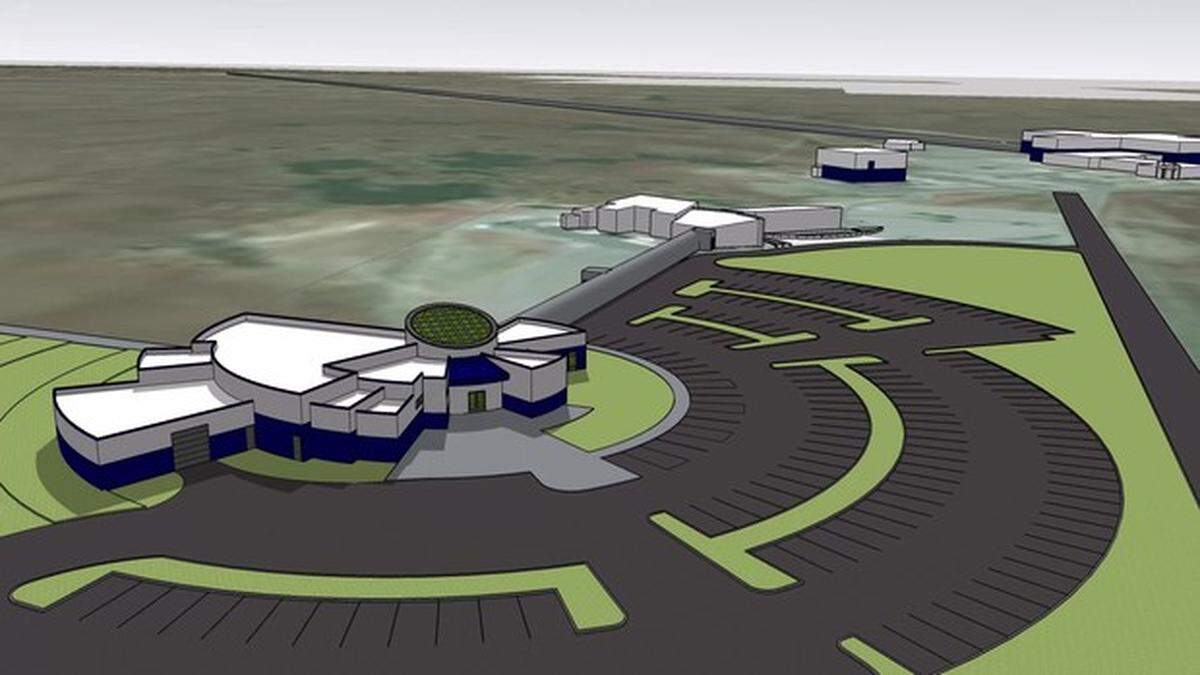
DGR Grant Construction of Richland is building the center.
“It is sort of the epitome of the Tri-Cities — science, engineering and math — but in a way that brings students in, gets them learning hands on, gets them engaged,” said Chris Reykdal, Washington state superintendent of public instruction. His office distributed the grant.
For adults, seeing a Nobel Prize, one of several given to each winner to share with institutions, may be a highlight. But for kids the highlight of the new center may be a giant funnel to demonstrate the principles of gravity.
Students will enjoy and be challenged and compelled by the experiences they will have on the exhibits in this facility, said Dale Ingram, a Richland High School science teacher and the former LIGO Hanford outreach lead.
Washington state funding
It’s not just for students, but science enthusiasts of any age, and will be another Tri-Cities attraction for science tourism, he said.
Former state Rep. Larry Haler, R-Richland, had been championing the construction of an education center at LIGO since he attending a dedication center for Advanced LIGO in May 2015, months before LIGO’s first detection of gravitational waves.
Advanced LIGO was a major upgrade to the observatory that made it sensitive enough to detect gravitational waves for the first time.
“You have to be a natural optimist to try to detect wave lengths and changes in wave lengths at the level of one-ten-thousandths of the size of a proton,” Haler said in remarks for a virtual groundbreaking.
It also took optimism to ask the Legislature for funding for an astronomy-based education center in Eastern Washington, he said.
He and Washington state Sen. Sharon Brown, R-Richland, another advocate for the project, got help from Rai Weiss, LIGO founder and co-recipient of the Nobel Prize for discovery of gravitational waves, who spoke to legislators in Olympia about the importance of an education center at LIGO Hanford.
“LIGO is one of the few STEM research centers in the country where students can get up front and actually see, touch and feel what the scientists are doing,” Brown said.
LIGO was designed and built to be the world’s most sensitive and precise measuring device, said Dave Reitze, executive director of the LIGO Laboratory, which built and operate the LIGO Observatory.
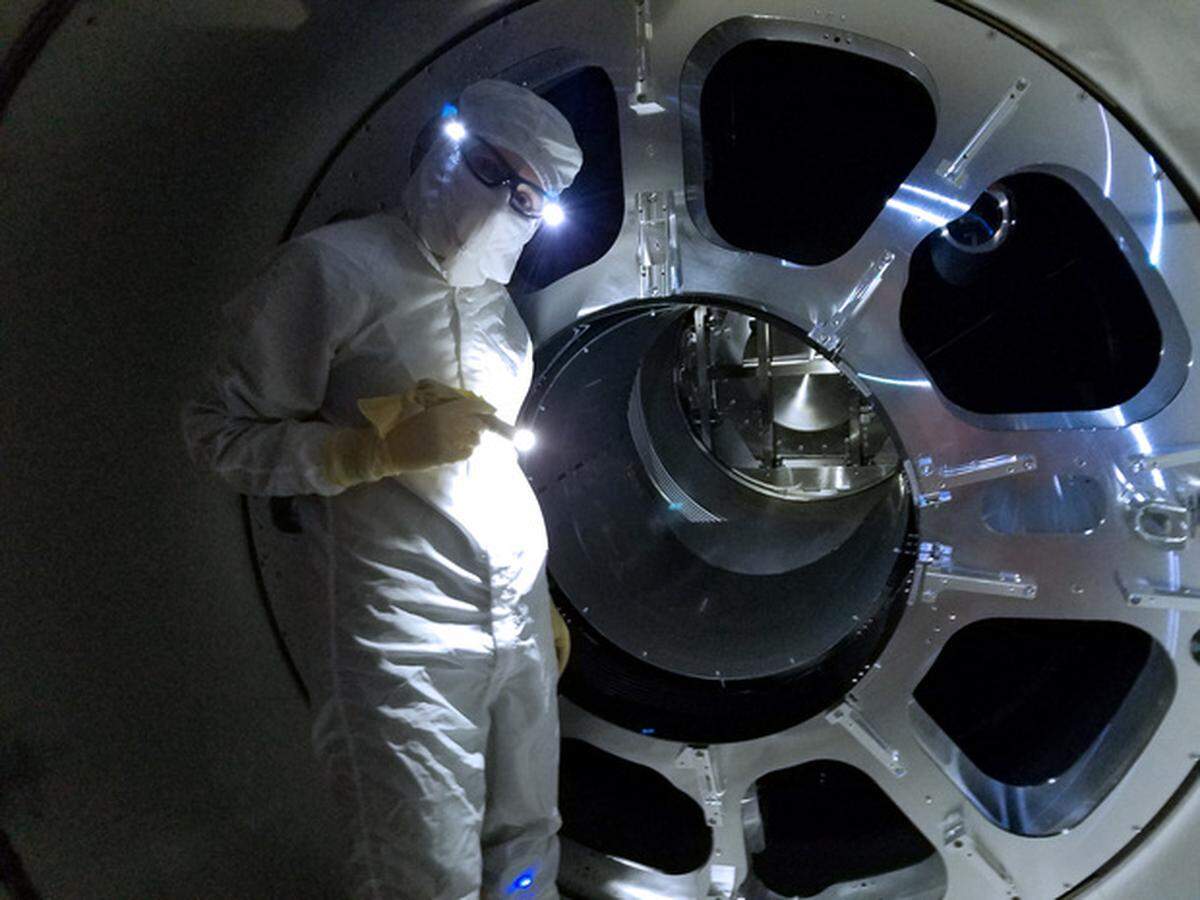
Unlike conventional observatories that use telescopes to see light in space, LIGO Hanford has two vacuum tubes extending for 2.5 miles across the Hanford shrub steppe at right angles. At the end of each, a mirror is suspended on fine wires.
A high-power laser beam is split to go down each tube, bouncing off the mirrors at each end. If the beam is undisturbed, it will bounce back and recombine perfectly.
But a gravitational wave can stretch objects lengthwise and cause them to compress sideways as it passes through.
If a gravitational wave is pulsing through the Earth, one of the tubes would be stretched slightly longer and the other would become slightly shorter, keeping the beams from recombining perfectly.
LIGO Hanford not only is a precise measuring device, but it has the world’s most stable lasers and its ultra-fast computer algorithms can search through data in real time to detect the feeblest of gravitational wave signals, Reitze said.
LIGO Hanford science
Since LIGO Hanford’s first discovery of gravitational waves in 2015, it has detected the gravitational waves from more black hole collisions, including in May 2019 the most massive source of gravitational waves yet detected.
The merger of a black hole with a mass 85 times that of the sun with one about 66 times the mass of the sun is believed to have created a black hole of about 142 solar masses and released an enormous amount of energy. Gravitational waves equal to the energy of eight suns were spread across the universe.
But LIGO’s most important detection may be the detection of the fiery collision of two neutron stars in August 2017, opening up a new field of astronomy.
The crash of the neutron stars — the collapsed cores of large stars — spewed material that radioactively decayed, creating heavy metals like gold and platinum.
Unlike black holes, colliding neutron stars emit a flash of light in the form of gamma rays. It allows the event to be captured both by LIGO and by observatories that observe forms of light, including X-ray, ultraviolet, infrared and radiowaves.
It was the first time that a cosmic event had been viewed in both gravitational waves and light, giving scientists a new way of learning about the universe through “multi-messenger astronomy.”
Students will learn about the science behind the discoveries at the new Exploration Center.
“Building this LIGO Exploration Center has been a dream of ours for the past 20 years, and now thanks to Washington state we are making it happen,” Reitze said.
“Our educational mission is this — to inspire a sense of wonder, to engage curiosity and to encourage and diversity the STEM workforce,” he said.
This story was originally published October 23, 2020 at 7:00 AM.