
Hazardous air persists in Tri-Cities. What’s it doing to your health?
Tuesday was day five of hazardous air conditions as the Tri-Cities, trapped beneath a shroud of smoke, counts down the days until possible relief on Friday.
That’s the soonest that some significant clearing could occur, says the National Weather Service.
A storm system is forecast to move across the region with a chance of rain and increased wind that could move some of the smoke.
“Air quality may gradually improve but will depend on rainfall, wind and ongoing fires,” the weather service said.
Tuesday winds continued to blow smoke into the Mid-Columbia from fires in Western Oregon and Northern California.
Health issues
Kadlec Regional Medical Center in Richland, the Tri-Cities largest hospital, has seen more patients with asthma seeking help because the smoky air has worsened their condition, said Dr. John Matheson, medical director of the Kadlec Emergency Departments.
“Anybody who has chronic lung conditions are more vulnerable and more likely to (seek care),” he said.
Kadlec didn’t have statistics on patients seeking help because of the smoke. But Stanford University in California reported that hospitals were seeing a 10% increase in hospitals admissions for asthma and a 23% jump in strokes and other cerebrovascular incidents as wildfires raged in California, according to The Guardian.
Strokes and cardiovascular problems have increased as a result of COVID-19, Matheson said, “and now we get the smoke.”
People with heart or lung conditions are at increased risk from breathing smoky air, he said. He’s concerned that some people, fearful of being exposed to the coronavirus may hesitate to seek care.
He urged people who think they may be having a heart attack or stroke to come to the emergency room immediately to prevent more dire consequences.
For people who are generally healthy the smoke still is not good for them but the effects are usually short term, Matheson said.
UW Medicine in Seattle is reporting more patients seeking care from ear, nose and throat care specialists for relief from sore throats, headaches, nasal congestion and earaches.
Some patients are surprised to learn that the ears, nose, and throat are connected, said Dr. Albert Merati, medical director of otolaryngology at UW Medical Center – Montlake.
“It’s all the same system,” he said. “Things that irritate your nose or throat would also irritate your ears.”
UW Medicine advises using an air purifier in your home or office and drinking water to increase circulation and flush your system.

How bad is it?
The Tri-Cities air quality was rated over 400 on Monday afternoon on the Washington state Department of Ecology’s air quality rating scale of 1 to 500. Any rating of 300 to 500 at the top of the scale is considered hazardous.
On Tuesday, there was some improvement in air quality with the rating dropping to about 310 in the morning and then increasing to the mid 300s.
A light rainfall in parts of Western Washington only slightly improved the air quality there, with most of the Interstate 5 corridor still rated as hazardous or very unhealthy.
The Tri-Cities forecast calls for a 50% chance of showers on Friday, followed by a decrease in the smoke in the air on Saturday.
Smoke closures
The smoke choking the Tri-Cities was further disrupting lives already restricted because of the coronavirus.
Many restaurants and bars have closed the outdoor seating they’ve come to rely on during the COVID-19 because of the smoky air.
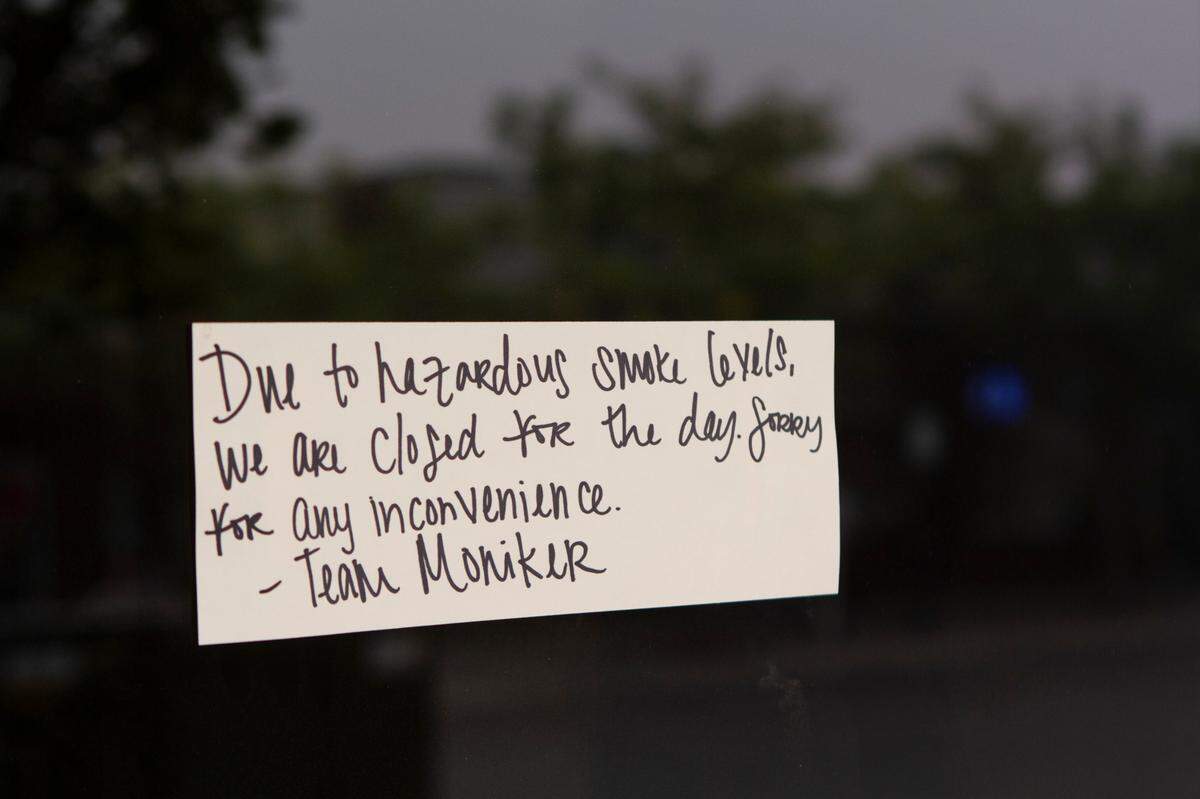
Both Sun Willows and Columbia Point golf courses in the Tri-Cities closed because of the bad air quality.
Hardware stores were mostly sold out of home furnace air filters.
They were in demand as filters quickly become clogged with smoke particles and as people used them in homemade air filtration systems.
They can be attached to the back of a box fan to help filter the air in small rooms. Box fans also were in short supply in the Tri-Cities.
Many of the students, mostly at private schools, who had started in-person classes in the Tri-Cities were told to stay home for a second day in a row, and most public school meal deliveries were canceled although families can pick them up at schools.
Most Hanford nuclear reservation workers also were told to stay home, some of the teleworking, because of the bad air quality.
Mid-Columbia Libraries offered curbside pickup only at its Basin City and Connell branches.
Mid-Columbia Meals on Wheels was planning to start a weekly drive-thru meal pick up service at its Meals on Wheels Cafe starting Wednesday, Sept. 16.
It is canceling the first scheduled drive-thru for its senior clients because of the smoky air but plans to offer a turkey dinner 11 a.m. to 1 p.m. Sept. 23 at the cafe at 1834 Fowler St.
This story was originally published September 15, 2020 at 12:23 PM.