
50,000 people expected to move to Pasco. Not everyone agrees where they should live
Pasco planners are working to solve a land jigsaw puzzle to meet the needs of the nearly 50,000 new residents they see moving into the city in the next 20 years.
They expect to need some 3,500 more acres in the city’s Urban Growth Area and are planning for more shopping areas and to put more housing in underdeveloped spots.
City officials believe their proposal will keep growth at a manageable level by keeping more people in the city and increasing the diversity of housing.
But some residents see the growth in west Pasco adding to road congestion, and some property owners are concerned the land they planned to turn into housing will be left out of the city.
“Pasco has a real opportunity to reinvent itself, much as the city of Seattle did when it rebuilt after the late 1880 fires,” said Bob Carosino, a Pasco resident and former environmental attorney.
“It is pure hyperbole and wishful thinking to believe that traffic volumes will be substantially reduced by whatever local shopping/retailing stores will develop in the Broadmoor area,” he wrote in comments to the city.
By putting more people on the western side of the city, he is concerned that it will make Road 68 and Road 100 even worse for drivers — as well as headaches on Interstate 182.
He believes the city needs to put more effort into mitigating the problems that could be created by the growth and look at expanding on the east side of town.
People have until July 31 to get their comments into the city about the new growth plan. The decision will set the boundary for what can become part of the city and what can’t.
By state law, the Urban Growth Area boundaries need approval from the county before they can become official.
Growth estimates
City planners are trying to find space for an estimated 48,000-50,000 people who are predicted to move to the area by 2038.
The city’s population more than doubled since 2000 when it swelled by 45,000.
“I think most people, the first time they see the number, they raise an eyebrow,” Zabell said. “That’s less of a growth rate then we’ve seen in the last 20 years.”
As they look at the land available, they face a large amount of unused space in the Riverview area, which senior planner Jacob Gonzalez described as having roads that end in people’s backyards.
“So much of the reason we have to expand 3,5000 acres, which is an extremely large expansion request, is because of the development pattern … in the Riverview area,” he said. “A lot of the underutilized vacant parcels that we find in Riverview could potentially have additional development on them.”
These same problems have made it too expensive to put water or sewer lines in the area — another problem they want to avoid with new development.
And Zabell contends most of the city’s infrastructure is designed for expansion on the west side of the city and wouldn’t be practical or economical to add huge housing projects on the east side.
Urban growth planning
This is the second time the city has tried to expand its urban growth area.
In 2018, the officials proposed adding about 4,800 acres to the city’s growth area, which would have pushed development much farther north.
In discussions with Franklin County, public agencies and community members wanted the city to better use the land inside its limits.
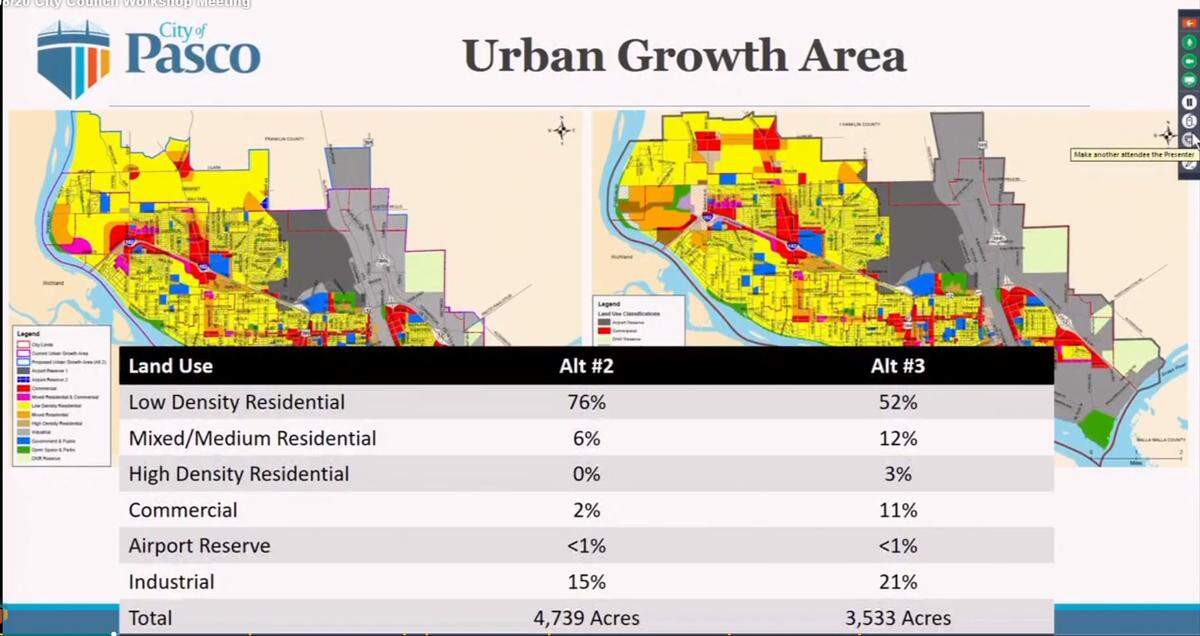
After a survey of nearly all of the properties inside the city, officials found parcels that could be developed but would only add housing for about a third of the population growth expected.
After the study, the officials decided on a boundary that could move the northern border of the city past Clark Road. Along the way, it would add two new areas for commercial development and increase the types of housing available.
“The goal would be to have more gentle density changes, so we’re not stacking all of our higher density residences in just one area of the city,” Gonzalez told the city council recently. “The better way of planning is to distribute that through the city.”
The city’s first plan would have ended up with 76 percent of the city as low-density housing. That has been brought down to 52 percent.
In addition, the planners are hoping to keep more people inside the city by offering more places to work and shop.
Right now, 75 percent of the people in Pasco leave the county for work, and more than a quarter of those drive along Interstate 182.
Increasing the places people can work inside the city will mean fewer people will be on the road heading to work.
More or less
Several land developers and property owners in the northern sections of Pasco feel left out of a chance to get their properties inside the urban growth area.
They spoke during a late June planning commission meeting to ask the city to stay with the boundary that was drawn in 2018.
They pointed out that areas like Clark’s Addition and housing developments along the Columbia River are already going up, and the property is not housing right now.
People moving into Pasco were looking for a single-family rambler home where they could park an RV or a boat, Pasco real estate agent George Dockstader said.
The drop in low-density residential homes will mean fewer of those are being built.
“You’re going to have cram in two-story houses on half-acre lots,” he told the planning commission. “This is about where our kids and grandkids are going to live.”
Community and Economic Development Director Rick White pointed out many of the properties that are being developed in the county have the same problem as Riverview. There are large sections of land that remain unused.
This story was originally published July 26, 2020 at 2:30 PM.