
‘I couldn’t take it.’ Tri-Citian left 1960s Hanford to fight for racial equality
Thinking about the current round of Black Lives Matter protests make Dallas Barnes grin.
“Our protests back in the 1960s were for our kids and our kids’ kids,” said the longtime Pasco resident. “Guess who’s protesting now? Our kids’ kids. We lived long enough to see that happen.”
A longtime advocate for disadvantaged students, a leader at Pasco’s Martin Luther King Jr. Community Center and a voice for Blacks at Washington State University, Barnes has been part of a long battle for equality.
The 79-year-old Barnes is still adding his voice to calls to end police brutality and systemic racism decades after the death of Martin Luther King Jr.
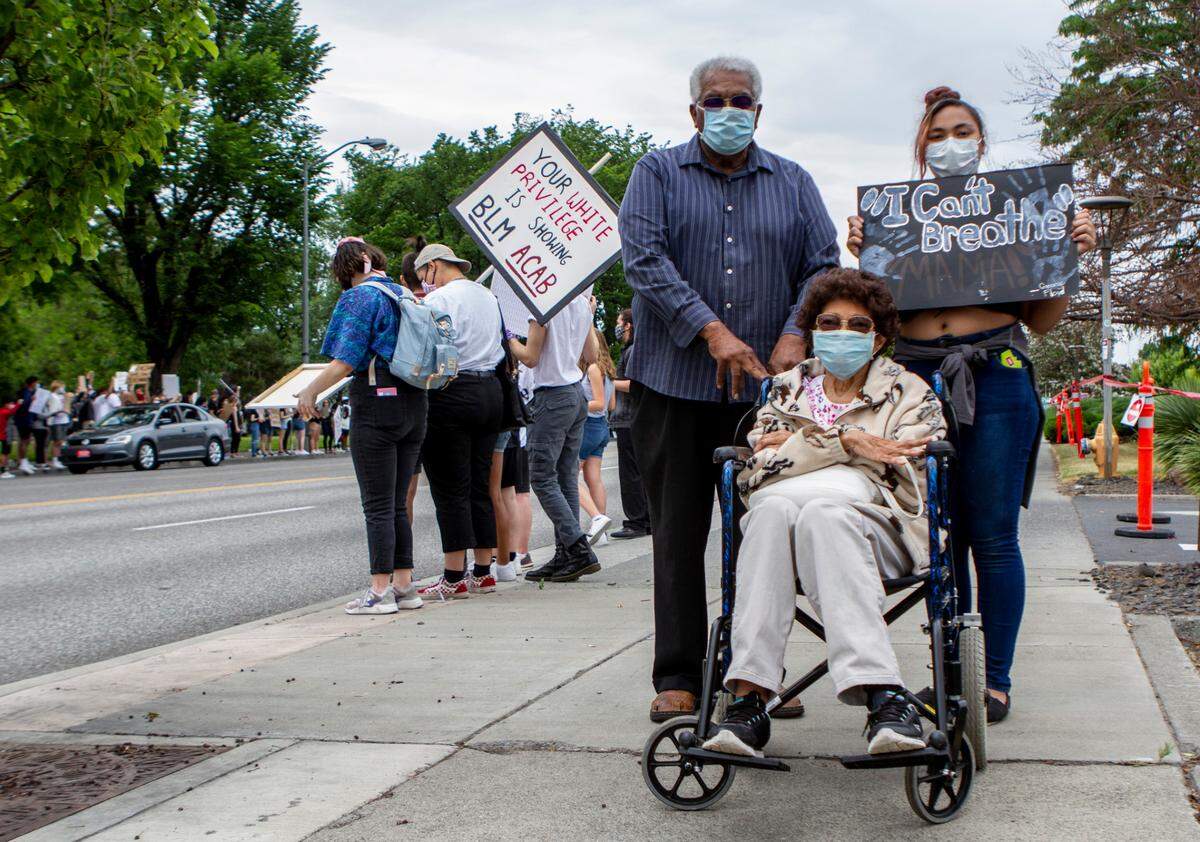
He and his wife, Lozie, joined other protesters in Pasco at a June rally — one of the first in the Tri-Cities after the death of George Floyd at the hands of Minneapolis police.
He called the protests and the movement uplifting, since it shows that the work that he and others have put into seeking an end to racism has not been in vain.
“These people have their eyes on the prize, and all they need to do is be empowered,” he told the Herald. “If they can generate this much energy without being fully empowered, what are they going to do when they get the information (they need)?”
Role models
There needs to be more education, and role models for Black people in the school system, Barnes said.
The problems with racism in country as deep and sewn into the language people use. He pointed out that having to say that a business is an equal opportunity employer means normally it’s not equal.
Barnes feels there is a legacy of racism that runs through many institutions including religion.
“I don’t think that the average person has been educated enough to know the degree that affects people who have to live in that environment every day,” he said. “I don’t think that they acknowledge that the normal is unequal.”
A segregated city
Barnes moved to what was a rural city of about slightly more than 10,000 people in 1952 from St. Louis. It was a surprising switch from a community that was entirely Black to one where he attended a predominately white elementary school.
He recognized the difference, but he said he was received fairly well.
He started to become aware of race when he went to high school, and he saw the star athlete couldn’t hope to be elevated to homecoming king.
“You never would get those positions where you were going to be escorting a white girl,” he said. “We had a position to be part of the pageantry, but you never got the No. 1 slot.”
The slights continued as he made his way through Columbia Basin College. His financial aid came with a work component, and he saw his white counterparts get the comfortable jobs, such as monitoring parking lots. At the same time, he was waking up early in the morning to move irrigation pumps.
“It wasn’t the kind of consciousness that left a scar,” he said. “I think in my personal experience, I was one of the boys. I went around with the white kids and all of the other other kids. I’m not sure if that’s because I was an athlete.”
There was segregation in the Tri-Cities at the time. Most of the Black families lived on the other side of the railroad tracks in Pasco, and weren’t welcome to live in Kennewick or Richland.
Barnes had to be careful when he went to some stores, because the merchant didn’t want him to try clothes on before he bought it, he said in an interview for the Hanford History Project.
“My familiarity with the institutionalized racism is more a reflection. For example, when I went to school both at Columbia Basin College and at Pasco, there were no Black employees,” he said. “Don’t get me wrong, we got some people in those public places in ‘67, ‘68 after Martin Luther King got killed.”
War on poverty
After spending time at Eastern Washington University, Barnes returned to the Tri-Cities in the early 1960s and worked at Hanford. Then, a moment in the ongoing Civil Rights struggle pushed him to join the War on Poverty.
“I could not take little young kids being beaten, and old women and people marching down for civil rights and I’m out there titrating a sample in the lab with that going on down in the South. I couldn’t take it,”
He helped start the Benton-Franklin Community Action Committee, which had a tutorial program, clothing distribution, and was involved in setting up the first family planning in the Tri-Cities.
He would go to farms where he tried to educate farmworkers about the programs they were eligible for. The effort was aimed at trying to get migrant workers to settle down so they could provide an education for their children. The effort was met with resistance by farmers.
After a couple of years, he started working with urban renewal, which was aimed at helping people move out of east Pasco and into portions of the city that they had been prevented from living in.
He found his outlook on race relations change as he became more involved and enlightened, he said. He remembered people of color being followed back to east Pasco from their Hanford jobs.
“We knew that we didn’t have people working in stores. If you had a good job, then you were working for the government,” he said. “If you weren’t working for the government, you were out on somebody’s farm, changing sprinklers or bailing hay.”
Washington State University
His community activism led him to Washington State University where he was recruited to help transition into a college that would be understanding of minority matters. He started working as a counselor while he finished his college degree.
At the time, it was labeled an experimental educational program that would bring students from all different backgrounds and races together, he said.
It was the start of a 47-year career with Washington State University. From 1968 to 1997 he was in Pullman, and then he spent the rest of his time at WSU Tri-Cities.
“I had an excellent experience for many years at that college. In many ways, WSU was at the forefront in their efforts to deal with diversity,” he said. “We wanted minorities to be distributed through the whole campus not just in minority affairs.”
At the time, he was the director of academic development programs. His relationships with the university administration became strained over time. He ended up in a lawsuit with the university. An attempt to fire him in 1993 led to a week of protests in Pullman.
He felt his responsibilities were being stripped and given to younger white administrators, according to a Seattle Times article about the $150,000 settlement by the school.
As part of those protests, Barnes remembered seeing students chant, “No Justice, No Peace.” He carried that experience into the current protests.
George Floyd protests
While Floyd’s death proved to be a tipping point for moving a large number of people to act, he said it’s only the latest in a long line of injustice that Blacks have faced in America.
“I don’t think it added anything to how we were feeling about all of the the killing that goes back to the time when they killed Martin Luther King or Medgar Evers or Malcolm X,” he said. “(George Floyd’s death) was the straw that broke the camel’s back because the camel was already carrying the load of all of those other straws.”
While the energy behind the Black Lives Matter protests following the death of George Floyd makes Barnes hopeful, he said they need to have a firm grasp of the history of Black people in America. It’s something he sees as eroded over time with people turning away from books like Tom Sawyer or Huckleberry Finn.
Without those roots in history, it’s easy for Barnes to see the movement getting toppled by the backlash against it.
He is skeptical about the movement’s focus on dealing with the police. He would like to see them aim at opening dialogues with city managers or city councils since they are the people in charge.
“The police chief is an employee,” he said. “This is not to say, ‘Don’t talk to them,’ but we need to talk to the city council,” he said. “Take your protest to the City Hall.”
He suggested having a ombudsman program, or some intermediary who can act like the voice of the public inside of city government.
He is also skeptical about decreasing police budgets, because there are truly bad actors and police are necessary to arrest them. He also doesn’t want protester anger to turn to violence against the police.
“We need a peaceful movement, but we need a disruptive movement. Can you be peaceful and disruptive? Yes, you can,” he said.
“When people tell you that you have permission to march, you’re not being heard. When people tell you can only speak for three minutes at a meeting once a month, you’re not being heard.”
This story was originally published July 20, 2020 at 5:00 AM.