
Coronavirus ‘victory gardens’ sprouting in Tri-Cities. People rush to raise chicks and food
Keith Silliman is used to seeing an influx of customers at Farmer’s Exchange once the sun starts to warm the Tri-Cities and lawns green-up.
But this is not a normal spring.
Most people are quarantined with their loved ones, and those venturing out to shop are thinking beyond the coronavirus pandemic that has practically brought the country to a standstill.
The downtown Kennewick business sold out of potato seeds in record time and has seen other vegetable seeds and starts, like onion sets, go out the door at a higher-than-normal rate.
“The nursery is for people who garden ... so they have their own fresh, homegrown produce to help mitigate this catastrophe,” Silliman, owner of the 97-year family business, told the Tri-City Herald. Lettuce and cabbage are some of the early crops that will be ready for harvest in as soon as two to three months.
And then there are the essential animal and livestock products, from food for chickens, ducks, rabbits, pigs and cattle to live backyard poultry.
“That’s probably the biggest issue is making sure the supply chain for feed is uninterrupted,” he said.
The store has had trouble keeping up with the demand for baby chicks, ducks and turkeys, which can be good for eggs or meat.
Silliman said hatcheries are trying to meet the growing need, and he’s made the request to be contacted in case of any overruns or cancellations by other vendors. His store does not have a limit on poultry and takes pre-orders until they are gone.
He says the desire of people to think about where their food supply is coming from and better prepare for the future is eerily similar to when the housing bubble crashed 12 years ago.
“They’re not saying anything like that but you can feel that there is a difference,” said Silliman about the nursery shoppers who aren’t just looking for landscaping flowers and plants.
“There is a direct parallel to the 2008 housing crunch, where people are economically worried and wanting to do whatever they can to alleviate whatever expense they can in the future,” he added. “So they’re planting their own produce and doing their own gardening.”
Victory gardens
Victory gardens date back to World War I when people were encouraged to plant vegetables, fruit and herbs both at home and in public parks to supplement their rations and boost morale.
The New York Times recently reported that coronavirus fears, scarce eggs and lockdown boredom have driven sales of live chickens, especially baby chicks, across the United States.
“People are panic-buying chickens like they did toilet paper,” Tom Watkins, vice president of Murray McMurray Hatchery in Webster, Iowa, told the Times.
Other local nurseries and stores like Ranch & Home, Lowe’s and The Home Depot are seeing similar trends.
In Kennewick, Silliman anticipates that tremendous uptick in sales of vegetable plants, feed and poultry to extend through April and likely into May.
Fewer customers
But just because the store has seen an increase in some sales doesn’t mean they’re not like so many other essential businesses, struggling with fewer customers as people adhere to stay-home orders, he said.
Farmer’s Exchange has 35 workers, and Silliman said he is trying to keep all of them employed and safe.
While some are doing behind-the-scenes work at home, those at the Canal Drive and Benton Street shops have started wearing custom-made T-shirts that say “6 feet” in large, white print.
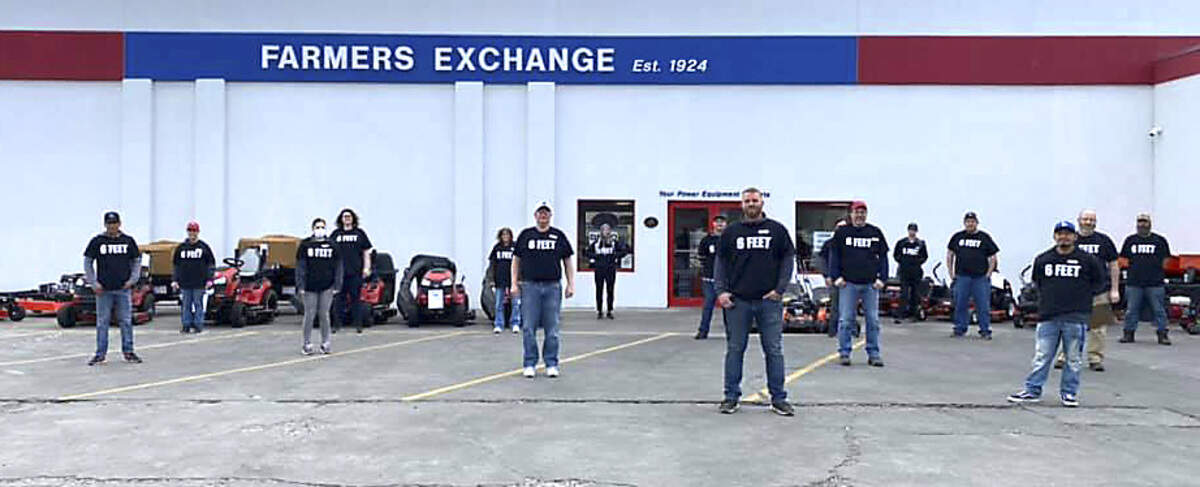
The owner said his staff is following both Centers for Disease Control and Prevention and Washington state guidelines — plus 25 percent.
That means even though their shirts say 6 feet, he’s instructed his crew to keep 8 feet from each other and customers for both their own protection and the protection and comfort of shoppers.
The store shut down two weekends ago so they could implement some changes, like limiting the number of people inside their buildings, placing physical barriers around checkout stands and using spray paint and tape to help direct customers. Their in-store limitations include one person per vehicle.
But Silliman emphasized that people need to respect protocols in place at all businesses, to help curb the spread of COVID-19.
“We empower the customers’ brains to respect protocols and signage and direction because we’re still seeing a little bit of resistance to this, like, ‘It’s not real’ or ‘I’m denying that it’s happening’ or ‘I don’t care.’ We must get the message out that it is,” he said.
And he has trained staff to have full control of their safety and space during this outbreak. Under his own no-tolerance order, they are told to stop, walk away from a customer and get a supervisor if they are feeling endangered.
“You might get out of the house once a week to the farm store. We deal with hundreds (of people) daily.”