
Here’s how much irrigation water KID customers can expect this season
Water users — from homeowners to farmers — who rely on the Yakima Basin Water Supply should have adequate supplies for the coming irrigation season.
The U.S. Bureau of Reclamation forecast indicates the water supply will fully satisfy senior water rights, and others should have a 90 percent water supply.
That includes the Kennewick Irrigation District.
“If everything holds and the prediction is correct, it should be like a normal year,” said Jason McShane, engineering and operations manager for the Kennewick Irrigation District.

Water officials were grateful for the February snowfall in the Yakima basin after the much drier than usual January, said Chuck Garner, Yakima Project River Operations supervisor for the Bureau of Reclamation.
“The mountain snowpack that feeds our reservoirs is only 80 to 90 percent of average range,” he said. “However, this should provide the Yakima Project an adequate water supply this coming irrigation district.”
More snow could fall in the Cascade Mountains to feed the Yakima River into May, McShane said.
The current forecast is the first one released this year, with monthly forecasts planned through July.
Forecast water supply could change
Whether the water supply holds at its current level will depend on how much precipitation is received in the coming months and if temperatures remain cold enough to prevent the snowpack from melting too soon.
The demand for water from the Yakima Basin is about 2.4 million acre feet for the irrigation season, but only enough storage is available for 1 million acre feet of water.
The March Bureau of Reclamation water supply forecast is based on water flows, precipitation, snowpack and reservoir storage as of March 1, along with estimates of future precipitation and river flows.
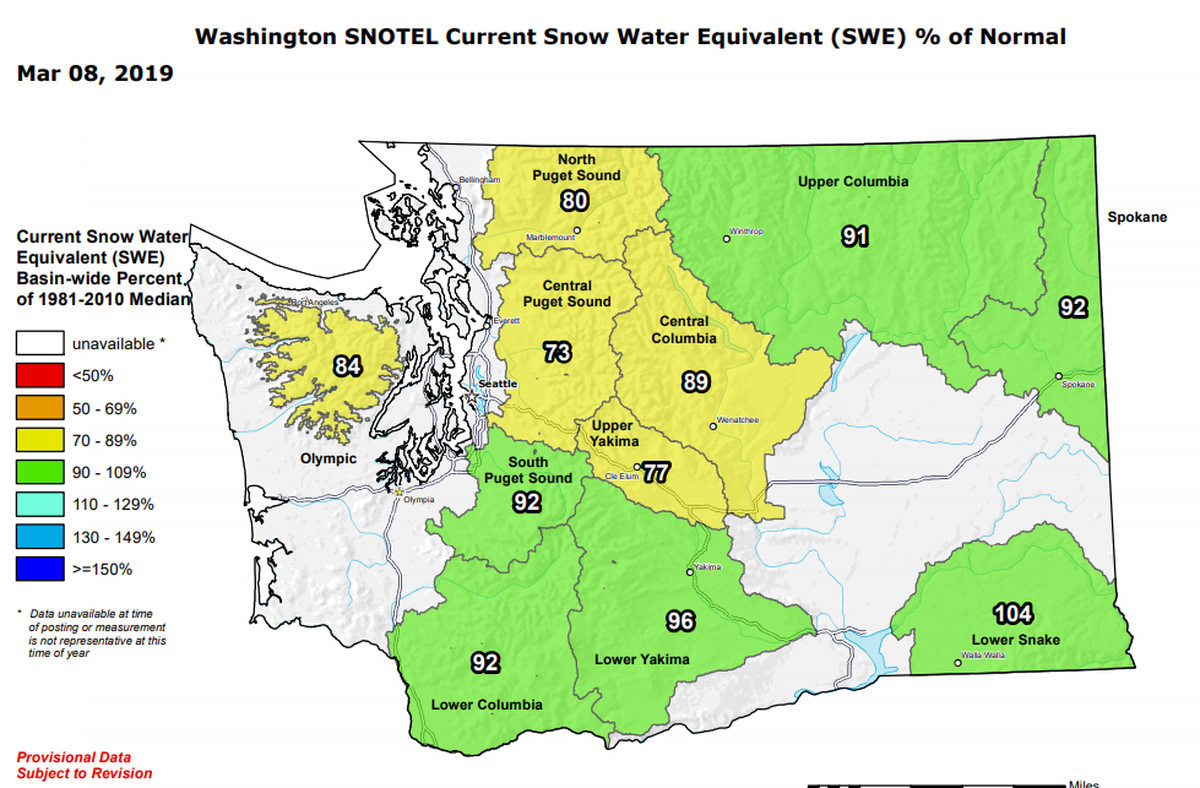
“We still have several key months ahead of us that can have a big influence on the ultimate water supply this summer,” Garner said.
The National Oceanic and Atmospheric Administration’s long-range outlook for Eastern Washington says that a warmer than usual spring in Eastern Washington and much of the Cascade Mountains is possible and that a warmer than usual summer across the state is likely.
The spring and summer also may be drier than usual in the state.
KID says customers should always use water wisely.
Lawns should be trained to grow deep roots to withstand dry periods by watering grass less frequently for long durations. The Tri-Cities receives an average of just seven inches of precipitation a year.
This story was originally published March 9, 2019 at 3:51 PM.