
UPDATE: Richland's shoreline is flooding. Here's why
It's a gorgeous day to go to a riverfront park, but watch out for the dangerous river levels in Richland.
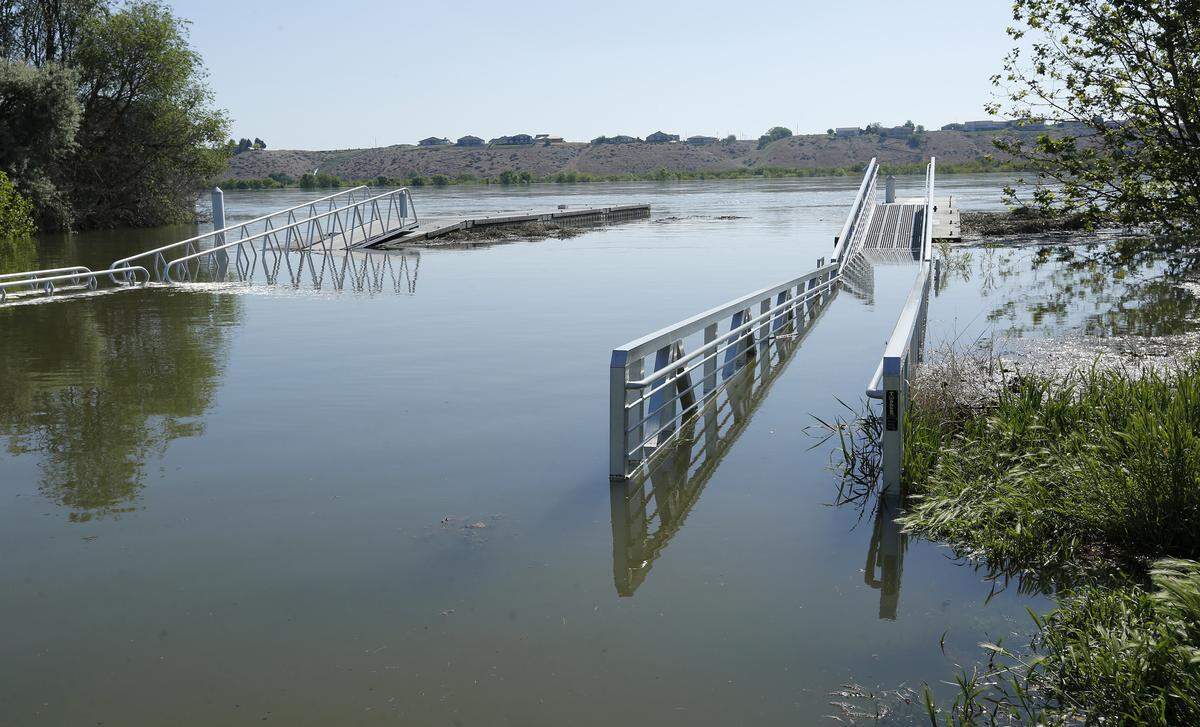
Parts of Howard Amon and Leslie Groves parks in Richland are underwater because of high and fast water coming down the Columbia River.
Docks and benches are unreachable without trudging through the high water.
The combination of snow melt and rain upstream caused Washington state Gov. Jay Inslee to declare a state of emergency in 20 Eastern Washington counties, including Benton and Franklin counties.
Rising flood waters are threatening a nearly century-old dam near Leavenworth, and downstream residents are being told to be prepared to evacuate.
The high water in Richland is not considered serious.
Joe Schiessl, Richland's parks and public facilities director, said city officials might close some small areas of the parks during the flooding.
What comes next is still up in the air. Shoreline erosion is the most typical problem, and Richland will have to restore it, Schiessl said.
"We never know what kind of issues we face until the water recedes," he said.
Heavy snow melt is flowing down the river from Canada, with recent rains adding to the high water levels.
In some areas of Canada the snow pack was at 140 percent of normal this spring, said Lynne Brougher, public affairs specialist for Grand Coulee Dam.
Just below Priest Rapids Dam on the Columbia River upstream from Richland, the water was near flood stage Monday morning at 31.7 feet.
It dropped to 31 feet, which is still considered full to its banks early Monday afternoon, according the National Weather Service.
The Okanogan River, a tributary to the Columbia River, was well above flood stage Monday. Flood stage near Tonasket is 15 feet and the river depth was measured at 21 feet at 1 p.m. Monday.
The outflow from Grand Coulee Dam on the Columbia River was 290,700 cubic feet per second on Monday, with each cubic foot roughly the size of a basketball, Brougher said.
That's nearly 2.5 times the average outflow of 110,000 cubic feet per second.
It would have been more, but Grand Coulee officials were anticipating a high water year and had emptied Lake Roosevelt behind the dam lower than usual to store water from northern Idaho and western Montana.
Part of the dam's function is to control the flow of the river and help control flooding, Brougher said.
Some water is being stored and other water is being spilled over the dam and used to generate electricity.
"Continued higher temperatures are predicted to increase snow melt and cause additional flooding as rivers and streams continue to rise to record or near record levels," Inslee said.
Inslee said that the increased threat of flooding in Eastern Washington could last until the weekend. River levels may lower some then but could still be high for a couple of weeks.
Richland city officials recommended caution to anyone visiting Howard Amon Park or using the River Trail path.
Carly McDaniel posted a photo and comment to the city's Facebook page showing a bench under many inches of water.
Another commenter said she'd never seen the river that high before.
The Yakima River also will be running high again later this week, but no flooding beyond some low-lying pastures is anticipated.
The National Weather Service predicts it will crest at the Kiona gauge near Benton City, the closest upriver from the Tri-Cities, on Friday at a couple inches below the top of its banks.
This story was originally published May 14, 2018 at 12:40 PM with the headline "UPDATE: Richland's shoreline is flooding. Here's why."