
COVID takes Tri-Cities economy down, but not out. The challenges ahead
Tri-Cities workers paid with federal dollars will help bring the local economy out of its coronavirus-induced recession as more businesses are allowed to reopen, said Karl Dye, president of the Tri-City Development Council.
Even as the number of cases of COVID-19 has dropped sharply, the Tri-Cities still faces challenges, ranging from a rate that remains high to businesses that have been hard hit and people still out of work.
A bright spot has been the federal stimulus act passed by Congress and signed by President Trump that ensures that nearly all of about 11,000 employees at the Hanford nuclear reservation continue to be paid, even if they are not among the limited crews allowed on site now.
The 4,700 workers at Pacific Northwest National Laboratory, most of them based in Richland, also are covered by the bill, even if they cannot telecommute.
“It keeps dollars in our economy,” said Dye, who was among the speakers to the Columbia Basin Badger Club last week who shared their perspectives on how the Tri-Cities area is coping.
Those Hanford and PNNL workers and a few others in the Tri-Cities with wages paid by the federal government make up 11% of the total workforce in Benton and Franklin counties.
But they account for 23% of the wages paid in the area, Dye said.
COVID and Tri-Cities economy
“As we come back out of COVID, (with) those workers who have still been paid there is pent-up demand for goods and services,” he said.
As more businesses are allowed to reopen, that spending will “drive many, many jobs and for the Tri-Cities bring us out of the recession we are in now even faster,” he said.
Federal workers are among the fortunate.
The May and June state unemployment report showed a 3% decrease in unemployment in the two counties, he said.
But there still were 11,000 fewer people working in those two months than a year before, he said.
The hospitality industry has been hardest hit by mandated closures and changes in consumer behavior during the pandemic, he said.
The industry includes hotels as few people are traveling and bars and restaurants that are not allowed to offer indoor dining and service while the Tri-Cities remains in a modified Phase 1 of the state’s reopening plan.
The Tri-Cities area appears to have been hit harder by unemployment than by sales tax losses, he said.
There have been reductions overall in the sales of taxable goods, locally, he said. But car sales have been reasonably good and the big box stores remain open, with both helping sales tax collections.
Business recruiting
Businesses have continued to be interested in relocating to the Tri-Cities, he said.
Over the last six months TRIDEC has been approached and then put together proposals six times for businesses looking for new sites.
Three of the projects remain active. Dye described them as being in the areas of warehouse, logistics and manufacturing.
The area continues to be of interest to businesses interested in new types of nuclear projects, including work related to small modular or micro reactors, fuel production or new nuclear uses for space travel, he said.
COVID and public health
Despite the declining number of new cases in the Tri-Cities, public health has some major challenges ahead, Dr. Amy Person, health officer for the Benton Franklin Health District, said at the Badger Club forum.
Near term, she’s concerned about Labor Day weekend gatherings spreading the coronavirus and causing a spike in new cases just as public schools appear to have a chance of reopening later this fall.
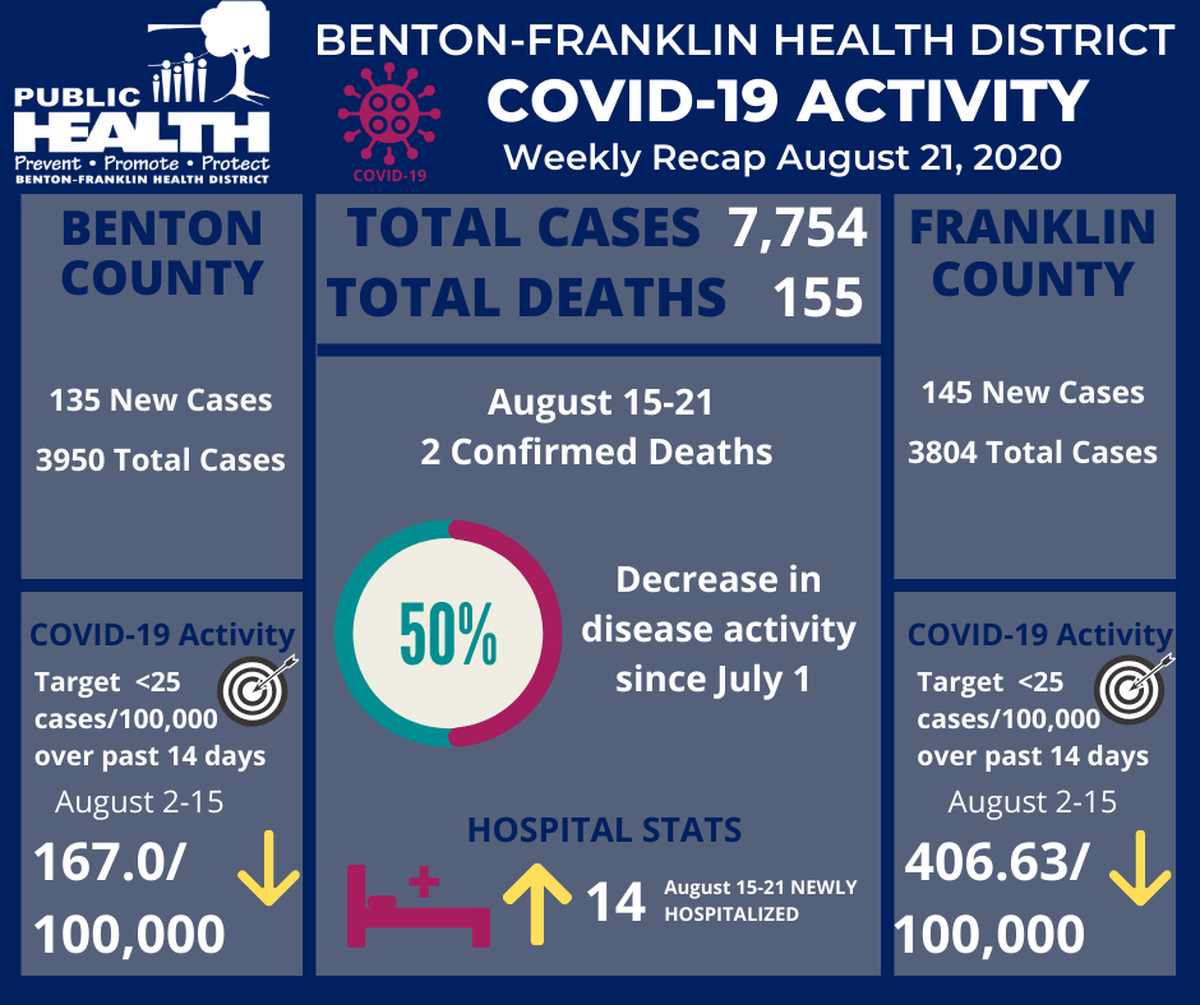
Benton County is down to about 140-150 new cases per 100,000 people for the past two weeks and Franklin County is down to about 370-380 new cases per 100,000 people for the past two weeks, she said.
Benton County, in particular, has a new case rate that is dropping fast enough that it could reach 75 cases per 100,000 people in a couple of months. That is the new case level at which state recommendations say schools can return to partial in-person classes.
But after other holidays this spring and summer, cases have spiked as people have held barbecues and other gatherings, spreading the infection.
Longer term she’s concerned about what she calls “vaccine hesitancy,” which was a problem even before the pandemic started and researchers began racing to develop a vaccine to prevent COVID-19.
National surveys have shown that just 42% of people are interested in getting vaccinated to protect against the coronavirus, she said.
But having herd immunity — enough people immune to stop disease spread — has been achieved in modern times for contagious diseases through vaccines, she said.
COVID ‘infodemic’
At the same time the nation is facing a pandemic, it also if facing an “infodemic,” Dr. Person said.
“It’s the proliferation of misinformation, old information or just deliberate hoaxes ... that add to the continued confusion that people have around what is COVID — Is it real and serious? Should we even care about it?” she said.
Public health officials learned that it is not enough to have the knowledge and facts, she said.

They also have to be the source that people trust and are used to turning to for health information.
Unfortunately, some of the sources people do trust for health information are not accurate, she said.
The Benton Franklin Health District has relied on getting help from sources people appear to trust in the area, including local political and government leaders.
Some city and county officials have stepped up to provide factual information, including promoting the use of masks, she said.
Public service announcements and signs have made it difficult for anyone to say they didn’t know that they should be wearing a face covering, she said.
She also said that the pandemic has made clear the disparity in health care available locally and nationally.
In the state of Washington 43% of cases have been reported in Hispanic people, who make up just 13% of the population, with statistics based only on cases in which race or ethnicity were reported.
COVID weekly update
The past week, Aug. 15-21, was better than the week before in the Tri-Cities area by some metrics measuring the effects and spread of COVID-19.
Two deaths from the coronavirus were confirmed in Benton and Franklin counties, down from eight the week before.
The number of new cases dropped from 337 to 280. Benton County new cases actually increased from 125 the week of Aug. 8-14 to 135 the past week, but Franklin county cases dropped from 212 to 145.
The number of new hospital patients being treated for COVID-19 locally increased to 14 in the past week, from 10 the week before.
The latest death from COVID-19 and 47 more cases in the two counties were reported on Friday, with the local health district releasing new information only on weekdays.
The new cases on Friday brought the average new confirmed cases per day for the past 14 days to 43. For the past 28 days new cases have averaged 60 per day.
This story was originally published August 22, 2020 at 1:23 PM.