
Why local health experts say Tri-Cities should reopen. And where COVID is spreading
Deciding how to reopen the Tri-Cities likely will be one of the hardest the state has had to make.
Benton and Franklin counties continue to be plagued by ongoing coronavirus outbreaks and the number of new cases is growing, Dr. John Wiesman, secretary of the Washington Department of Health said this week.
Still, both counties submitted applications to the state this week asking to move to Phase 2 to loosen some restrictions and reopen more businesses.
But no decision was issued by Friday.
The 60-page applications give the most detailed look to date at who is being hardest hit with COVID-19 cases and why Tri-City officials believe it’s time to move forward.
With the exception of Benton, Franklin and Yakima counties, every other county in the state has moved to another phase of reopening, with people allowed to eat at restaurants, have their hair cut and gather in small groups.
Wiesman could approve a move to Phase 2 of reopening or he could deny one or both of the applications.
His other option is to allow what’s been called Phase 1.5 — a more limited reopening of more businesses.
Time to reopen?
Public health officials question how effective the “lock down” of the community is after three months, given the large gatherings that residents are openly posting about on social media, they said.
“There is a growing perception of Phase 1 restrictions as punishment,” the Tri-Cities area application said.
“No matter the intent, the perception that the current restrictions are unfair has resulted in oppositional or defiant behaviors,” the application said.
“Individuals feel more alienated, leading to increasing social fragmentation and discord in the community.”
Not allowing people to shop at nonessential stores, eat and drink in restaurants and bars, or to get their hair and nails done encourages people in Benton and Franklin counties to travel to other nearby counties already allowing those activities, it said.
That has not only economic impacts on the Tri-Cities, as local money is spent elsewhere, but also creates the potential for cases to be spread to other counties, according to letters of support from local governments included in the application.
Also concerning are posts on social media calling for people not to get tested to keep cases from being counted in the state-set targets for low case counts that are considered for reopening, the application said.
If people don’t get tested, early identification of cases and their contacts cannot be done to control the spread, it said.
The “economic, social and emotional consequences of prolonged unemployment, business closure and isolation” has been difficult on the community, they wrote.
The health district is telling people to make changes to their behavior, including wearing masks in public, not visiting family and friends, staying home from work when feeling only slightly ill, and maintaining a distance of six feet from non-household members.
It’s particularly difficult to make those changes when people are worried about how they can feed their children or pay their rent, said Dr. Amy Person, the Benton Franklin Health District health officer, in the recent Kadlec on Call podcast.
Pandemic shifting
The coronavirus pandemic has hit the Hispanic population in the Tri-Cities area particularly hard, according to the application.
Data is incomplete, with just 75% of the confirmed cases reported to the local health district providing information on race or ethnicity.
But according to available information, 47% of cases in Benton County are in the Hispanic population, although the total population is only 23% Hispanic.
In Franklin County the total population is 56% Hispanic, but Latinos account for 79% of the cases.
“Many of our Spanish-speaking residents are essential workforce,” said Kathleen Clary-Cooke, a spokeswoman for the Benton Franklin Health District.
And many of them have jobs in crowded settings, she said.
If just the cases linked to outbreaks — other than in long-term care facilities — the percentage of cases in Latinos increases to 53% in Benton County and 86% in Franklin County.
But the pandemic in the Tri-Cities has continued to evolve.
“We expect the disease burden will likely shift away from that demographic,” Clary-Cooke said.
At this point the majority of cases are not being spread through outbreaks, such as in work spaces or in long-term care homes.
Instead, they are what public health officials call community spread — people gathering in social or extended family groups, at protests and for sports practices and tournaments.
Business outbreaks
The applications for reopening detail the outbreaks, which is one of the metrics being considered by the Washington state Department of Health in the applications.
In the last week of May there were 21 outbreaks at different places in the two counties, up from 15 at the start of the month.
Throughout the month of May a diverse set of workplaces reported outbreaks, which are defined as two or more linked cases within 14 days in a workplace or other organization or facility.
Stores with outbreaks included the Kennewick Walmart with five employees testing positive and Fiesta Foods in Pasco with two cases. Viera’s Bakery had six cases.
The only restaurant on the list was the McDonald’s in Prosser with two cases.
Other organizations included Basin Disposal with two cases and Benton County Fire District 4 with four cases.
But the majority of outbreaks were in agriculture and food processing and storage operations.
They included during various weeks in May Gourmet Trading with 20 employee cases; Pasco Processing with 18; Easterday Farms with 12 cases; Lamb Weston in Pasco with 11; Simplot with nine; Twin City Foods with 10; Douglas Fruit with five; Lineage Logistics cold storage with three; Baker Produce with three and Five D Farms with two.
In addition, Coyote Ridge Correctional Center had 101 cases reported as of Friday, including 70 inmates and 31 employees.
The outbreak in long-term care homes and retirement centers has hit at least 11 homes with more than one staff member or resident diagnosed with COVID-19. There have been a total of 211 cases in residents and 114 in staff.
Now that outbreak in homes for seniors is mostly over, with only a few new cases per week reported.
It’s an example of effective infection control, Clary-Cooke said.
Residents were isolated, cleaning was increased, staff wore masks and gloves, and residents were grouped together based on their health status, with separate staff assigned to areas with residents who had COVID-19.
Testing, quarantine sites
The application also lists the testing sites in Benton and Franklin counties, saying there are now 11 places where people may be tested in the two counties.
Addresses, hours of service and information on appointments is posted online at bit.ly/TCtestingsites.
And the application covers places available for isolation or quarantine, including 89 beds set aside at four Tri-Cities hotels and motels and at a teen shelter in Kennewick.
Some are available to the general public, who pay their own expenses. They may have vulnerable family members at home who they don’t want to expose.
The government will pay for rooms for the homeless at Motel 6, with county government responsible for payment.
In addition, some area fire departments or districts have negotiated hotel contracts for their first responders who need a place to isolate or quarantine away from family.
Rising case count
Among the major shortfalls covered in the applications to move to Phase 2 are the high number of cases in the Tri-Cities area.
The state target is no more than 50 cases total in two weeks in Benton County and no more than 24 cases in Franklin County.
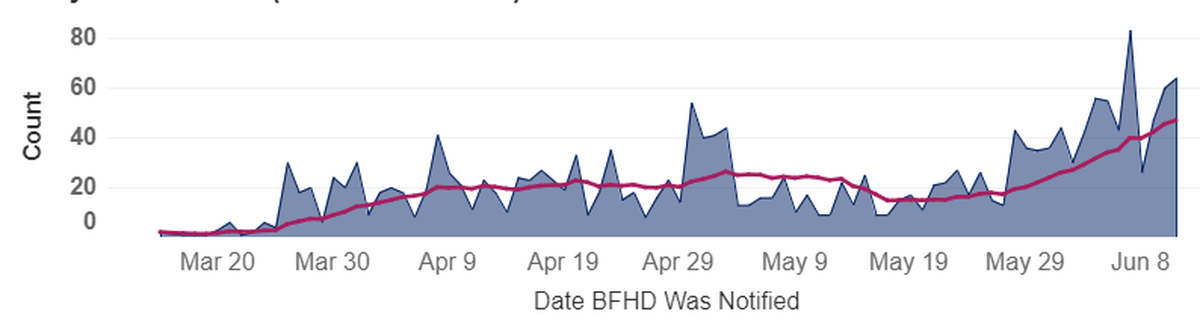
With 68 confirmed cases reported Friday alone — 42 in Benton County and 26 in Franklin County — the Tri-Cities area is far from meeting that target.

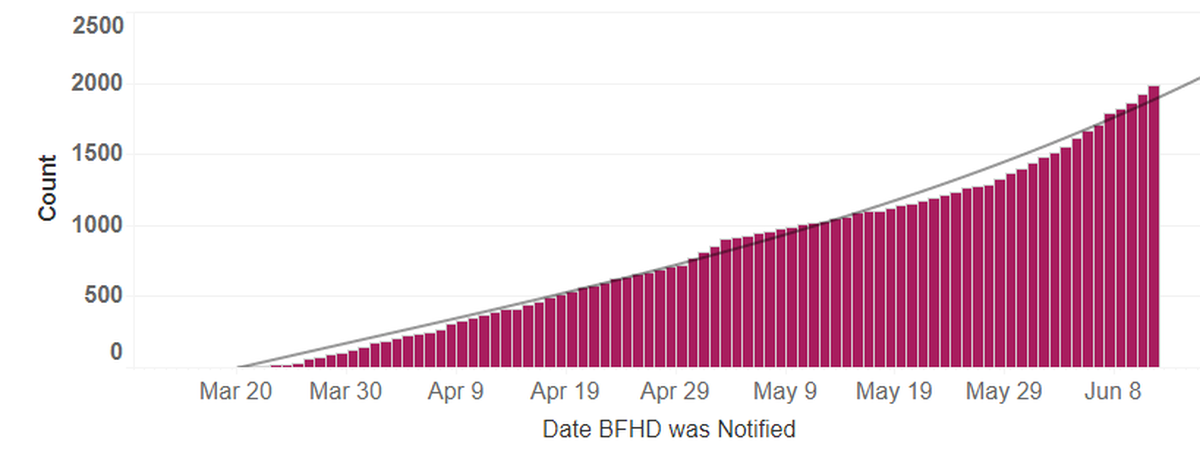
Over the past two weeks Benton County has had a total of 329 cases and Franklin County has had 328, which is just over 23 per day on average in each county.
Cases for the most recent week were higher, increasing from 40 on average per day for both counties in the first week to 54 the second week.
The local health district also announced three more deaths on Friday, for a total of 93 since the start of the pandemic.
They include the youngest person to die yet in the Tri-Cities area, a Franklin County man in his 40s. Whether he had underlying health conditions was not immediately known.
The other two new deaths were a Franklin County man in his 70s and a Benton County woman in her 90s.
The number of patients hospitalized with suspected or confirmed cases of COVID-19 also hit a new high over the past week. There were as many as 68 people hospitalized at once.
They made up as much as 24% of total patients in the hospitals in Richland, Kennewick, Pasco and Prosser. That does not meet a state reopening target that is based on COVID-19 cases per licensed beds.
The age of those with COVID-19 has dropped as the coronavirus has spread through the community in recent weeks, and younger people are being hospitalized, said Dr. Person.
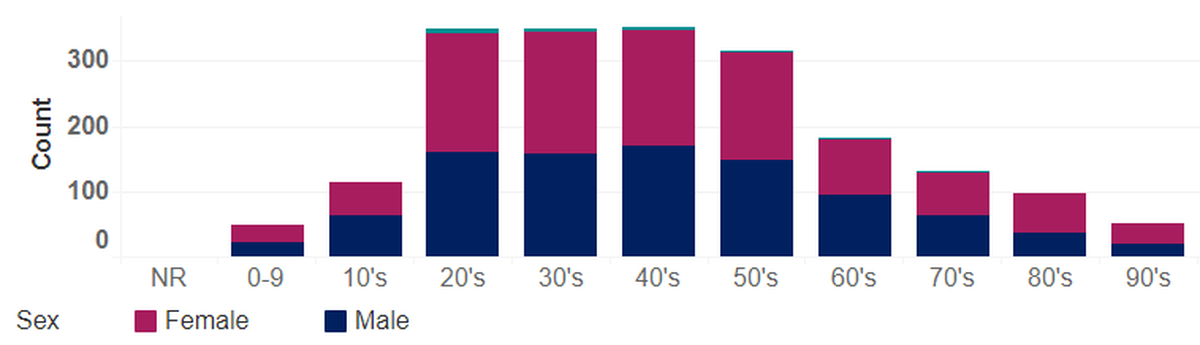
Now people in their 20s, 30s and 40s make up the majority of people who have been diagnosed with COVID-19 since the start of the outbreak.
The 162 children and teens diagnosed with COVID-19 are a particular concern to public health officials.
They are at risk of multisystem inflammatory syndrome in children, a severe illness associated with COVID-19.
One Franklin County child younger than 10 already was diagnosed with the illness and transferred to Seattle Children’s Hospital for treatment.
This story was originally published June 13, 2020 at 2:09 PM.