‘Beyond 100% recovered.’ Tri-Cities jobs break records. So why the struggle to find workers?
The Tri-Cities set new record lows for unemployment in November, but that means new challenges for job seekers and employers heading into 2022.
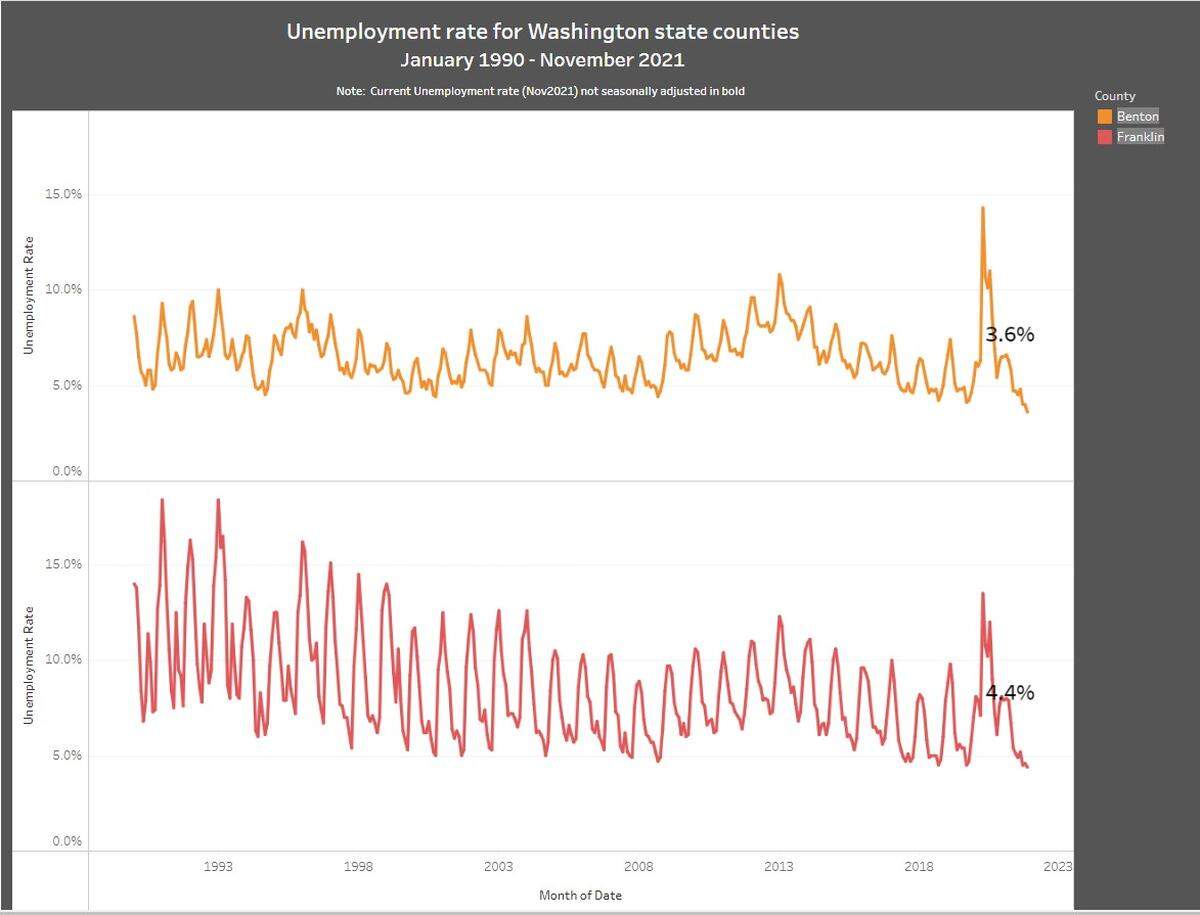
New data from the Washington Employment Security Department has the unemployment rate for November at just 4.4% in Franklin County and 3.6% in Benton County.
Those are the lowest levels since the department began tracking monthly unemployment rates by county in 1990.
Experts tell the Tri-City Herald what employees and businesses are facing in coming months.
Recovered and growing
Benton-Franklin Workforce Development Council Chief Operations Officer David Chavey-Reynaud said that not only has the Tri-Cities labor market recovered from COVID-19 peaks, there are now more people working than before.
“In terms of the number of jobs that are currently in the Tri-Cities, and our recovery from a year and a half ago, we’re beyond 100% recovered,” he said. “Compared to the number of jobs we lost in April 2020, we’ve recovered approximate 116% of those jobs. However that recovery has not been evenly spread across all markets.”
Chavey-Reynaud said that while unemployment is low, business owners might be struggling to staff because of a number of reasons.
He said that an expected wave of jobseekers never manifested near the end of summer when unemployment benefits began to max out for those who lost their jobs early in the pandemic.
And while government sector jobs have seen recovery, financial sector jobs which saw a boom during the pandemic are beginning to cool off.
“The only constant there has been throughout the pandemic, is the unpredictability of it all,” he said. “Some people haven’t gone back to work, but we’ve also seen a lot of people take the pandemic as an opportunity to train and transition into a new industry.”
Chavey-Reynaud said childcare also is proving to be an obstacle for those wanting to return to the workforce. Not only is childcare often cost-prohibitive, but he said job seekers that can afford it are having trouble finding openings for their children.
Jobseekers decide
With plenty of growth in warehouse and industrial work, many that left the service industry have gone back to school or looked for more stability.
That’s led to a more competitive labor market, especially for jobs that don’t require a college degree.
“In terms of a lot of these basic jobs that are hiring, we are seeing a lot of businesses competing for the same limited (pool),” Chavey-Reynaud said. “The competition that we are seeing between businesses is taking place at the wage level, and we’re seeing a lot more emphasis being placed on benefits and flexibility.”
Some of those benefits include flexible scheduling, remote work opportunities, better time-off packages and help paying for college or skills training.
“The baseline we’ve continuously heard is, ‘Why would someone continue to work at a break-your-back, mentally and physically challenging position when you can go to a (competitor) that’s offering more pay and better benefits?” he said.
Chavey-Reynaud said the Workforce Development Council can help business owners ensure their job listings are competitive and help them create positions that jobseekers will want to apply for.
“We’re working with businesses to try and find ways they can make their businesses more attractive,” he said. “We have a full-time business services team at Worksource who will work with clients to post positions, craft positions to be as attractive as possible, and once posted we can refer jobseekers to them.”
Business owners can also take advantage of assistance with layoff aversion, referrals, training and other opportunities.
“We have people actively coming in looking for jobs and looking for training,” he said. “For any business that’s struggling to hire right now, my advice is to reach out to our Workforce Services team and see what we can do to help.”
Worksource Columbia Basin is seeing requests for services for both business owners and jobseekers. Chavey-Reynaud said the business services team is there to help bridge that gap.
Looking Ahead
Asja Suljic is the Employment Security Department’s regional economist for Southeast Washington, which includes Asotin, Benton, Columbia, Franklin, Garfield and Walla Walla counties.
Suljic said the Tri-Cities has been, and is expected to continue, experiencing higher than average growth in terms of both local population growing and workers moving to the area. That growth will continue to provide a strong labor force in the region.
“Our average growth over the past 10 years has been around 2.5% a year, which is pretty much unheard of for many other areas in the state or the nation,” Suljic said
Nationally, that number is less than 1% per year, hovering around 0.6% annually over the past five years, according to U.S. Census Data.
And 2021 saw a national growth rate of just 0.1%, marking the first time since 1937 that the U.S. population grew by less than 1 million people.
Suljic said the much higher rate of growth in the Tri-Cities also translates to a growing labor force, which is attractive to businesses looking to relocate to the area.
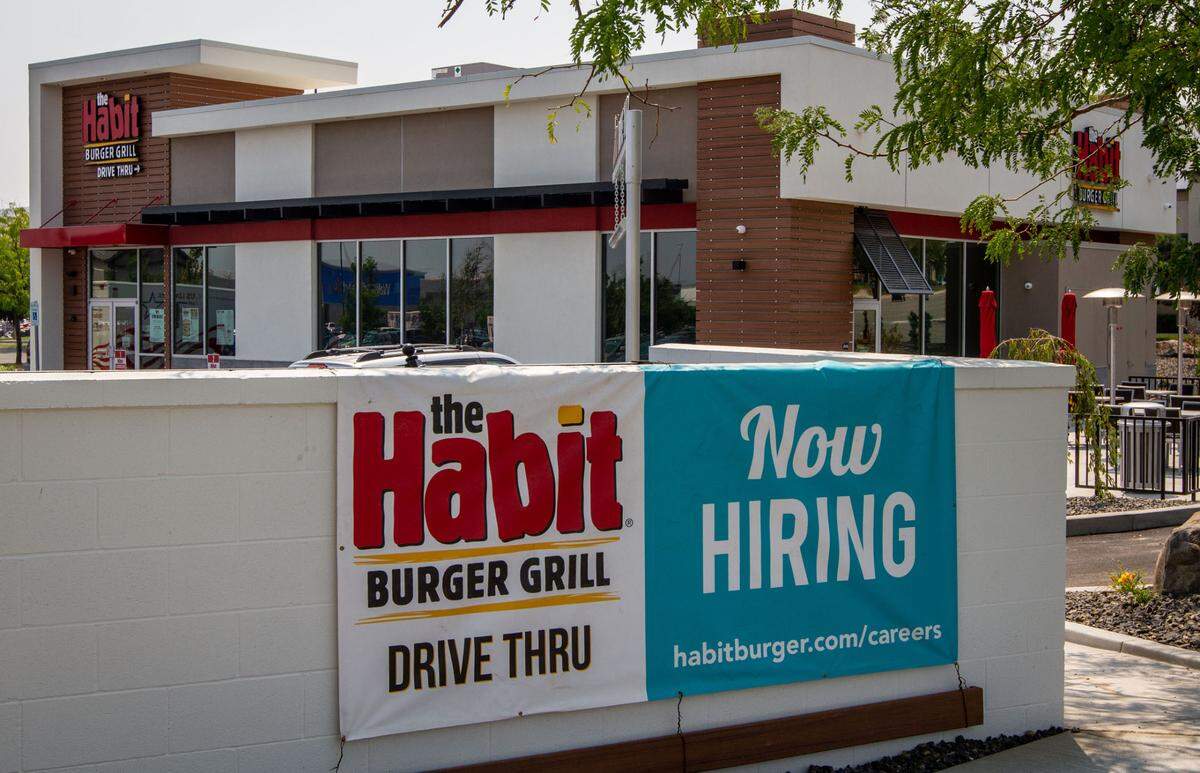
“Most of the jobs coming here locally tend to be entry level to mid-range experience demand, requiring only a high school diploma and on the job training,” she said.
“That means the individuals who want to enter the labor force will be able to do that. With that in mind, we can prosper based on our population growth, and at the same time we’ll be attracting a lot of labor coming into our community as well.”
Suljic said that the Tri-Cities is in a great position for growth because over the past few decades, the area has focused on growing industries across the board, from healthcare to manufacturing to agricultural work, alongside the rise in services that come with a growing population.
Amazon, Darigold and Reser’s Fine Foods are a few examples of large companies expanding in the Tri-Cities that will soon be competing for workers.
“We diversified other industries to supply demand for food and services for populations that are coming here, which creates opportunity for more options in those industries,” she said. “When you combine all of that, it diversifies us even more and brings stability for daily workers who make minimum or middle wages.”
By the numbers
November numbers from the Washington State Employment Security Department show both Benton and Franklin Counties in full recovery from the COVID-19 recession. The data goes back to 1990, and shows that more people than ever have found gainful employment in Tri-Cities.
Like the rest of the country, the Tri-Cities was hit hard by early pandemic restrictions. Uncertainty and attempts to mitigate the impact of the virus saw unemployment skyrocket in April 2020, to 14.3% in Benton County and 13.5% in Franklin County.
While high, those numbers show that the area was faring a little better than the rest of Washington, with the state average hitting 16.3%.
By the end of Summer 2020, unemployment rates in the Tri-Cities had moved back into the single digits and have continued to drop.
This year’s high came in February, with Franklin at 8% and Benton at 6.6%.
Franklin County matched its historic low in September at 4.5%, before a 0.1% uptick in October. November 2021 numbers show Franklin setting a new low of 4.4%
September also saw Benton County hitting its record low of 4% in September, before setting a new record in November at 3.6% unemployment.
The state’s unemployment rate is defined as all individuals 16 and older, engaged in the labor force and looking to find employment.
This story was originally published January 2, 2022 at 5:00 AM.