
It took money and mission of billionaires for the US to land a world-class coach
In June and July 2024, frustration burned through American soccer. The U.S. men’s national team had just crashed out of the Copa América, a prestigious continental tournament. As bitter fans trudged down ramps at Arrowhead Stadium in Kansas City, Missouri, some chanted for the firing of coach Gregg Berhalter. In group chats, others vented. They thought the team had plateaued. Some thought a world-class coach was needed to revive potential before the 2026 World Cup.
There were, however, problems with that plan.
The United States had never produced a world-class men’s soccer coach. And in theory, it had neither the soccer prestige nor the players to woo one from abroad. Historically, the U.S. Soccer Federation also lacked the necessary budget. Big names seemed like long shots.
What the United States did have, though, was ambition -- and billionaires and corporations willing to fund it.
Those benefactors became a key piece of the puzzle when U.S. Soccer did fire Berhalter and went in search of a successor. As federation executives advanced in talks with Mauricio Pochettino, who had recently parted ways with the English club Chelsea, they also spoke with sponsors and potential donors. They worked out a deal that would ultimately pay Pochettino several million dollars annually, a deal that U.S. Soccer said was “supported in significant part by a philanthropic leadership gift from Kenneth C. Griffin,” founder and CEO of Citadel.
“Additional support,” U.S. Soccer added, was provided by Scott Goodwin, a founder of Diameter Capital, another hedge fund; and by commercial partners.
Without them, the hire would not have happened -- well, unless Pochettino, 54, an Argentine, was willing to work for much less, U.S. Soccer President Cindy Parlow Cone said.
It has not necessarily been linear and ascendant. Pochettino’s 20 months in charge have been rocky. He has spoken about how he identified problems, destroyed the things that needed to be destroyed and started to build the house from the ground up. Doing so took pain, losses and time.
But if the United States succeeds at the 2026 World Cup, Pochettino will receive plaudits, and his wealthy backers will look back on their investments as worth it. Because they saw the donations as more than just a boost to help a team win; they saw an opportunity to elevate soccer in America.
‘I’ll Pay’
Berhalter, who was hired in 2018 and re-signed in 2023, made around $1.7 million a year, including bonuses. That was a record for a U.S.-born men’s national team coach. Bob Bradley, the previous one, made less than $1 million a year in the late 2000s. Jürgen Klinsmann, a high-profile German coach who led the U.S. team from 2011-16, was the exception: He made more than $3 million by the end of his second contract, according to U.S. Soccer tax filings.
Klinsmann, though, was not an accomplished club coach. To lure one with a big name and a lengthy coaching resume, in 2024, U.S. Soccer knew it would need an unprecedented financial outlay.
Executives were undeterred.
“We started with a list of who we thought were the world’s best coaches,” J.T. Batson, CEO of U.S. Soccer, said.
Among those they approached was Jürgen Klopp, who won Champions League and Premier League titles at Liverpool. And when that approach leaked to the news media, one day after Berhalter had been fired, the same fans who had fumed in group chats during the Copa América suddenly began dreaming.
One of those fans was Goodwin.
Goodwin, who was born in France and spent time in Spain, had stayed in tune with soccer as he rose in the finance industry. In a text thread with three friends, two of them former professional players who still work in soccer, he had been ranting about the woes of the U.S. men’s team. When he saw names like Klopp, Goodwin wrote to the group, “Let’s get these guys.” When one former pro told him that the top coaches might be unaffordable, he responded, “I’ll pay.”
And he meant it.
One of the former pros connected him with U.S. Soccer, and before long, he was meeting on a video call with Leah Burton, the federation’s chief advancement officer.
Soon after that, he was meeting with Batson over breakfast at Locanda Verde in New York City.
They spent two hours talking through visions for the future of American soccer, and Batson, in a way, made the same pitch that he had been making to coaches.
If they -- donors or coaches -- leapt on board and drove the U.S. men’s team deep into the 2026 World Cup, the pitch went, they could help change the course of soccer in the United States. They could inspire enthusiasm and participation among American children. They could leave a legacy.
“By the end of breakfast,” Batson recalled, “Scott was like, ‘I’m in -- and I’ll get other people in.’”
But with a catch, of course: Batson and U.S. Soccer’s sporting director, Matt Crocker, had to land a coach worth the money. To Goodwin, there were three names that fit the bill: Klopp, Pochettino and Manchester City’s Pep Guardiola.
Batson and Crocker chased at least two of them. They met Pochettino in July at a hotel in Barcelona, Spain. Over the coming weeks, they jetted around Europe, from the U.S. women’s national team’s run to Olympic gold in Paris back to Barcelona, where Pochettino lives. By August, they were confident they had persuaded Pochettino. But they had to figure out how to pay him.
That was when they went back to Goodwin. There was a gap, Goodwin said, between Pochettino’s salary expectations and what U.S. Soccer thought it could pay. Sponsors would fill half the gap, he was told; could Goodwin cover the other half?
Goodwin says he balked at the price but had a solution. He phoned Griffin, whom he had gotten to know in South Florida. When they sat down for lunch months earlier, they had chatted about soccer culture, everything from the youth landscape to Lionel Messi at Inter Miami. Griffin had a long-standing interest in the sport and had donated $8 million to the U.S. Soccer Foundation, a charitable organization, to fund the building of 100 small fields in Chicago and Florida’s Miami-Dade County.
So, Goodwin asked, would Griffin donate to the hiring of Pochettino?
The gist of Griffin’s answer was, “I’m in.”
(BEGIN OPTIONAL TRIM.)
Their reasons were similar. “You have a two- or three-year window now to try to make a difference in U.S. Soccer for the next five, 10, 15, 20 years,” Goodwin said in 2024. He thought that a coach “at the top level” -- like Emma Hayes, who received a record-breaking salary to lead the U.S. women’s team and almost instantly led the team to Olympic gold -- could “be a catalyst for long-term positive benefit, even if it’s a short-term agreement.”
Griffin did not agree to an interview, but Cason Carter, head of public affairs at Citadel, said in a statement: “Ken did this out of a deep love for soccer and a commitment to growing the game in the United States. He believes in inspiring more children to play, fostering the joy of competition and advancing the values that make sports meaningful.”
After a series of conversations, including with U.S. Soccer, the two made firm commitments. None of the entities involved have disclosed the size of their donations, but they were sufficient. Weeks later, after negotiations that were complicated by Pochettino’s messy separation agreement with Chelsea, U.S. Soccer announced him as its new men’s head coach.
(END OPTIONAL TRIM.)
Worth It?
In his first seven months on the job, from September 2024 to March 2025, Pochettino made roughly $5 million, according to tax filings. His signing bonus alone was $2.5 million. Although he is making less than he reportedly did at Chelsea or his previous club, Paris St.-Germain -- and less than some other top coaches in Europe -- he is, by far, the highest-paid employee in U.S. Soccer history.
At that seventh-month mark, he was also struggling. Many outsiders were questioning whether he was worth the hefty investment. Consecutive losses to Panama and Canada in March 2025 ended his honeymoon period. By the summer, he seemed to be at odds with his star, Christian Pulisic. The team was still underperforming. Those who argued all along that coaches were overvalued in international soccer seemed to have their case in point.
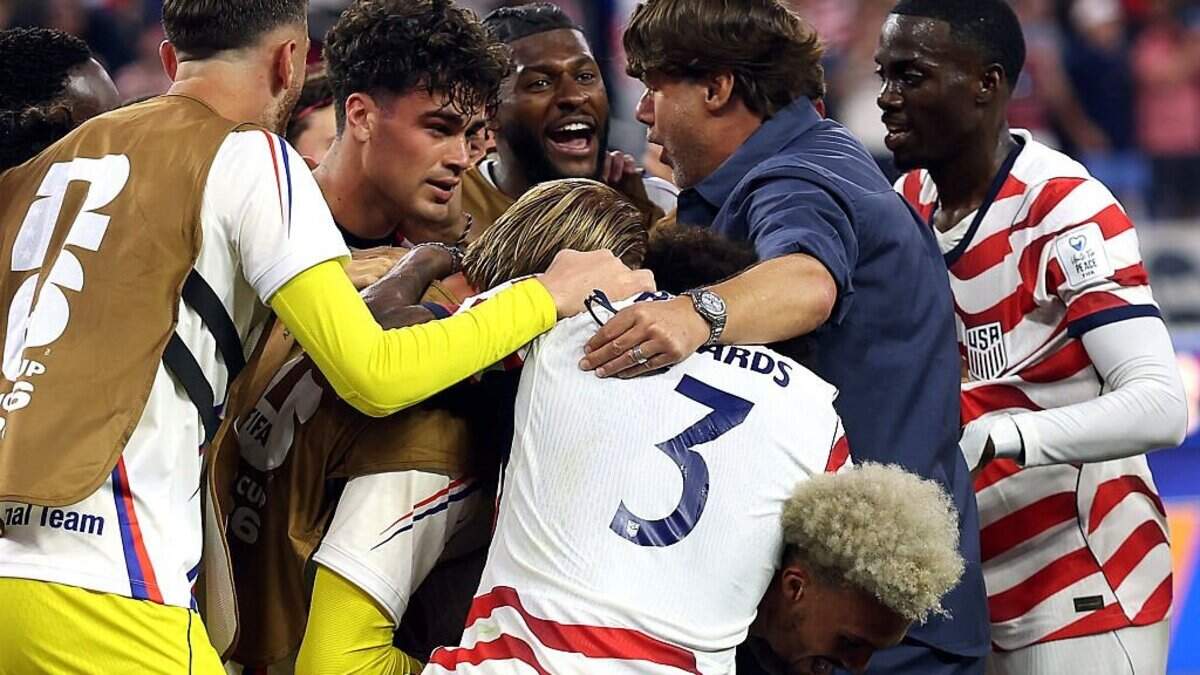
But then, Pochettino’s value began to show. The youngsters and fringe players he empowered became contributors. They routed Uruguay, 5-1, in November. Belgium and Portugal, with a pair of multiple-goal defeats, brought the U.S. men back to Earth. But a May 31 win against Senegal, and a promising performance against Germany, recharged belief. On Friday, in their World Cup opener, the Americans beat Paraguay, 4-1. Pochettino, it seems, has the U.S. men prepared for the brightest spotlights it will ever experience.
And that is precisely why U.S. Soccer, with help from deep pockets, went and got him.
(STORY CAN END HERE. OPTIONAL MATERIAL FOLLOWS.)
The hire, in this sense, was a paradigm shift. It was enabled by soaring revenue, but also by ambition. It fell right in line with other grand initiatives -- such as a $250 million national training center, fueled in part by a $50 million gift from Arthur Blank, a Home Depot founder.
“At U.S. Soccer, we had to shed a little bit of the ‘Little Engine That Could’ mentality,” Batson said. “And realize, no, no, we can be great, too. That’s our expectation on everything.
“There’s no reason why we can’t go win big things.”
This article originally appeared in The New York Times.
Copyright 2026 The New York Times Company