
Here’s what you won’t see at the Benton Franklin Fair this week
Don’t expect to see any chickens at the Benton Franklin Fair this year.
The poultry and rabbit barn is still open, but what you’ll find there in the poultry area are photos of chickens pinned to empty cages and an occasional cage with a fluffy stuffed or ceramic chicken displayed.
Washington state veterinarian Amber Itle recommended, but did not require, that fairs forego chickens this year due to the danger of avian influenza.
“The risk of commingling birds is significant and could result in the death of all birds that attend an event,” according to the Washington state Department of Agriculture website.
The recommendation was for any exhibition, poultry sale or fair until at least 30 days after the last detection of highly pathogenic avian influenza in the state.
Fewer cases are being detected in the state in domestic flocks, wild birds and mammals than earlier in the year. Sick and dead goslings began being reported at Columbia Park in Kennewick in May.
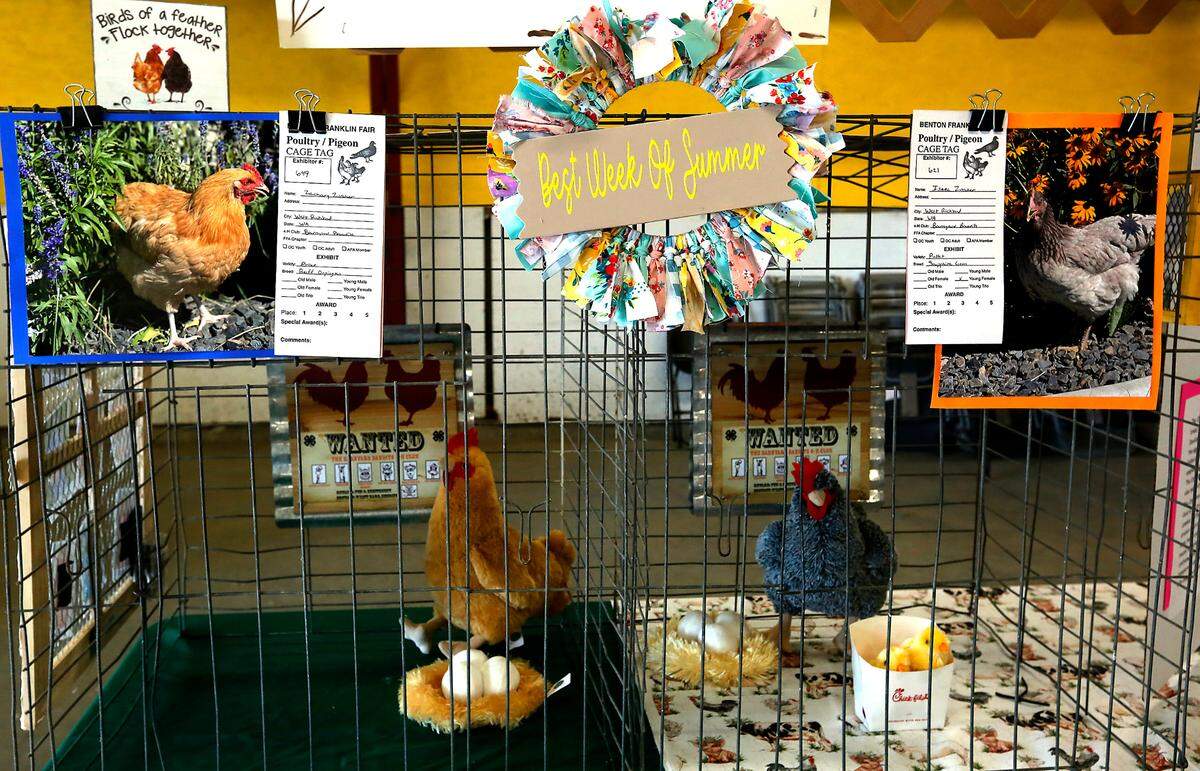
But there continue to be detections in neighboring states’ domestic flocks, according to the state ag officials.
And on Aug. 12 a small backyard flock of ducks in Walla Walla became the 31st in the state to have avian flu confirmed. Five days later bird flu was confirmed in a small flock of a mix of bird types in Kitsap County.
“While we had hoped cases would taper off now, current trends suggest that resident wild waterfowl are creating a reservoir of ongoing infection,” Itle said in a statement when the Walla Walla case was announced. “We must stay vigilant and prepared to respond for the coming weeks, and potentially months.”
Bird flu in Tri-Cities
No contaminated domestic flocks have been found in Benton or Franklin counties this year, but four Yakima County flocks and one Spokane County flock, all of them small, backyard flocks, have been discovered with the disease since May.
But Benton and Franklin have had cases in wildlife.
Franklin County had the first confirmed case of avian flu in a mammal in Washington state when four infected baby raccoons were discovered with the disease at Sacajawea Historical State Park in Pasco. Two were dead and the remaining two were euthanized.
It also was the first case of avian flu confirmed in a raccoon in North America, according to the Washington state Department of Fish and Wildlife.
Wild birds detected with avian flu in Benton and Franklin counties, in addition to young Canada geese, include a sandhill crane, an American crow, a mallard and a gull.
The biggest risk factor to domestic flocks in the state are direct contact with wild waterfowl.
From May 5 to at least Aug. 16, all confirmed infected domestic flocks had contact with wild waterfowl.
Domestic flocks can be protected by keeping birds under cover or fenced out of ponds or water sources shared with wild waterfowl where risk is highest, according to the state Department of Agriculture.
A single sick bird in a flock should be reported to your veterinarian. If multiple birds die or have an unusual illness, you are asked to call the state sick bird hotline at 800-606-3056.
There is no treatment for the disease.
Any sick or dead wild birds should be reported to the Washington Department of Fish and Wildlife’s website. Search wdfw.wa.gov for “report wildlife observations” to find the correct form.