
20 years of saving lives, averting disaster near Richland
On 88 acres just north of Richland fires rage and rescue workers rappel down the side of a building.
For 20 years the Department of Energy’s HAMMER training center has trained workers holding some of the nation’s most hazardous jobs, nuclear waste cleanup and emergency response.
The goal — save lives and avert disaster.
“This mission at HAMMER has been successful because it hues to some really basic American values and Washington values,” said Washington Gov. Jay Inslee, who stopped by the anniversary celebration on the HAMMER campus Thursday.
Its values include respect for working people, he said.
At Hanford workers “take risks wearing hot protective clothing, in confined spaces, in tough circumstances with some dangerous equipment and some dangerous equipment,” he said.
“We want you to get the best training humanly possible,” he told a crowd of workers, management, union officials and others. “And that’s what people get at HAMMER.”
HAMMER calls its training as “real as it gets,” making what it calls the nation’s most expansive selection of training props available to not only Hanford employees, but also to workers from the local to national level who must respond to emergencies and disasters.
Employees can learn confined space training in 210 feet of piping.
They can attempt mock rescues on a six-story tower equipped with smoke generators. They can practice approaching and extinguishing fires with props like a propane-fueled, electronically controlled fuel truck.
The training center is a first-of-a-kind partnership between management and union leadership, said Sen. Patty Murray, D-Wash., who sent video remarks.
“I don’t think you can find a better training program than Hanford,” said Richard Trumka, president of the AFL-CIO, in his video remarks.
Hanford is a particularly dangerous place to work, with workers exposed to an “unbelievable number of known and unknown hazards on a daily basis,” said Dan Stepano, general president for the Operative Plasterers’ and Cement Masons’ International Association in the United States and Canada.
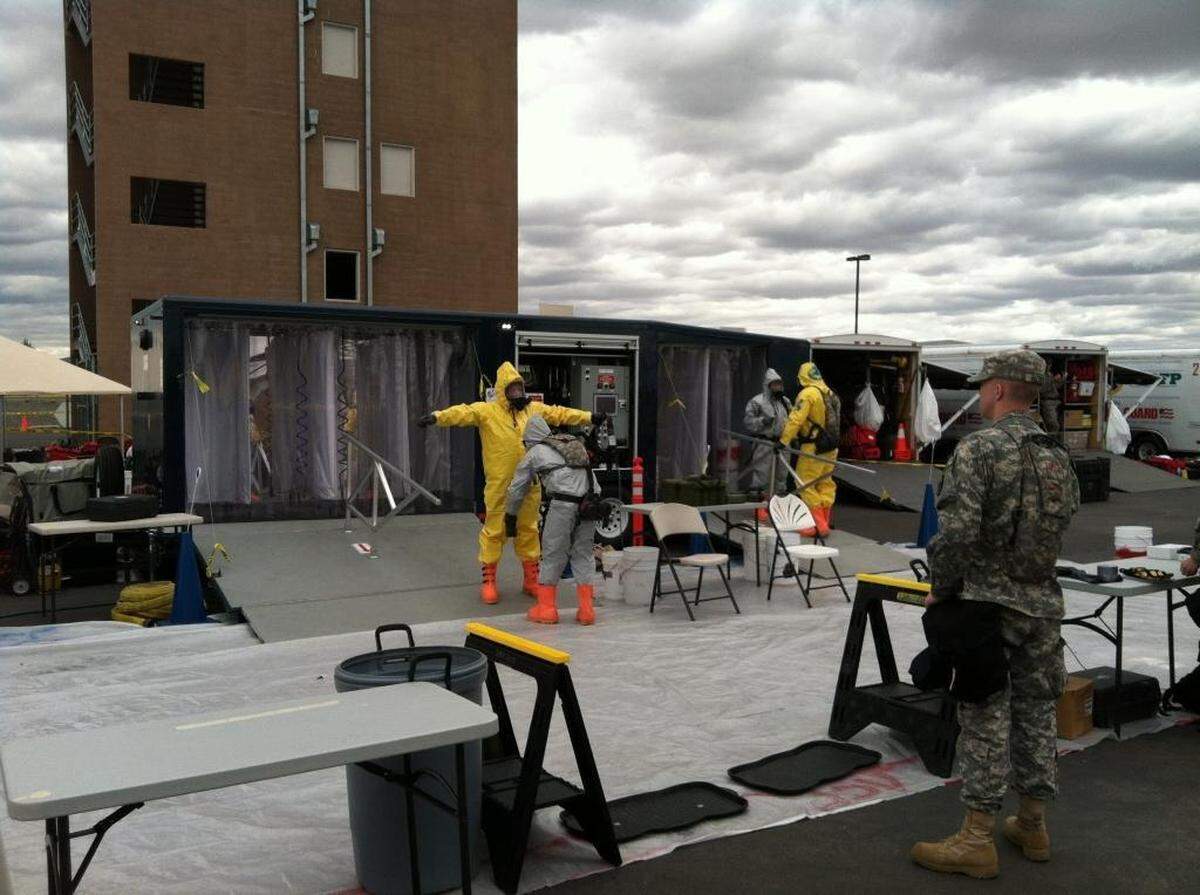
HAMMER uses experienced workers as instructors for a range of Hanford training, including respiratory protection, working with hazardous waste, radiation protection, fall protection and hoisting and rigging.
This year HAMMER is expected to offer more than 50,000 student days of training.
Inslee, who worked as a former congressman to get authorization for HAMMER in the early ’90s, said it is important to keep Congress’ attention on the training center and remind the nation that people continue to serve at the Hanford Site just as others serve in the Armed Forces.
“We have a mission that has not been completed yet from the Cold War,” Inslee said.
The nuclear reservation remains extensively contaminated, including its tank farms holding 56 million gallons of radioactive and chemical waste from the past production of plutonium for the nation’s nuclear weapons program.
“We need to stay focused on what is truly important,” said Eric Dean, general president of the International Association of Bridge, Structural, Ornamental and Reinforcing Iron Workers. “No job is worth a life.”
Annette Cary: 509-582-1533, @HanfordNews
This story was originally published October 5, 2017 at 8:15 PM with the headline "20 years of saving lives, averting disaster near Richland."