
Fortitude and innovation: A Tri-Cities scientist’s historic hand-cranked Rainier climb
Twenty years ago when Pete Rieke tackled Mount Rainier he was far from the first to summit the state’s highest peak.
But the Pasco scientist would be the first to climb it using only his arms.
The trek was a massive feat for the accomplished mountaineer who’d lost the use of his legs in a climbing accident six years earlier.
Most climbers suffering such a loss would have shifted their energies to other passions.
Not Pete.
From his hospital bed, he began asking how he might try to climb a mountain using entirely arm power.
“One of the things I realized when I suddenly became a wheelchair user was that I was going to develop the ability to maintain my own lifestyle,” said Rieke.
That tenacious attitude made the difference.
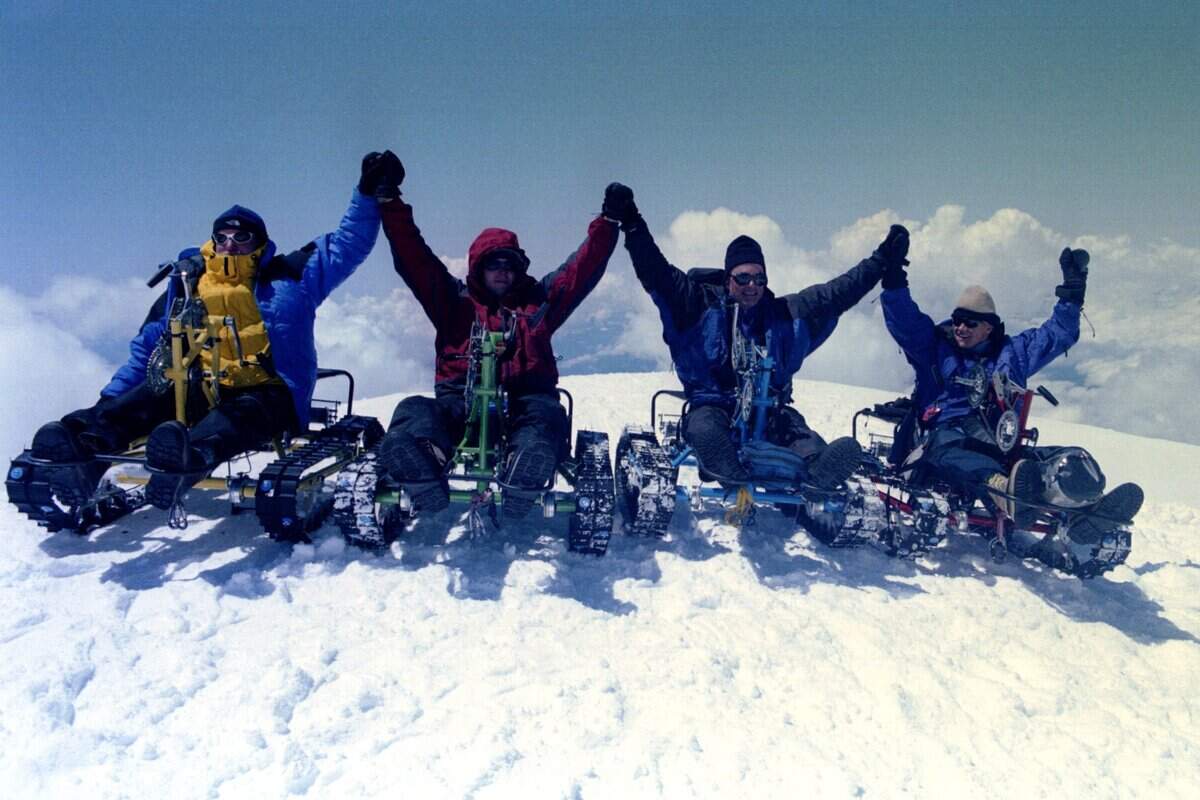
For the next three years, he worked with fellow scientists and engineers at the Pacific Northwest National Laboratory in Richland. Together, they developed a design, built a shop, bought the necessary lathes, mills and welders, and created a tractor-like device they dubbed the Snow Pod.
It weighed 65 pounds and had 48 combinations of gears. In its lowest gear it moved one inch with every turn of the crank.
Rieke spent hundreds of hours in the gym rebuilding his upper body. The engineering requirements demanded he be capable of nonstop cranking for 18 hours a day.
After many home and field tests and modifications, the Snow Pod was ready in April 1998 for the nearly 11,300-foot climb of Mount Hood — first big mountain he’d climbed as a teen growing up in Longview.
To the delight of Pete and his support crew from the Inter-Mountain Alpine Club, they reached the summit of Hood in three days.
Encouraged by their success, they turned their attention to Rainier the following June.
Momentous challenge
At 14,410 feet, Rainier would be much more of a challenge.
Although they ascended to 12,000 feet on Rainier, they were blocked by long and wide cracks called crevasses across the Emmons Glacier.
“After the first attempt, I think we were all kind of dejected, because we were so disorganized and we didn’t get to the summit,” Rieke recalled. “And I felt like one attempt was all we were ever going to get. But one of my good friends said to me at the campfire late one night, ‘these guys will go anywhere you want them to. Do it again next year.’ ”
So they tried again the following year, but chose instead a route up the Kautz Glacier, a more direct path but it involved crossing a dangerous gully with frequent rockfalls.
That attempt was blocked again, this time by hip-deep drifts of snow on a 50-degree slope that they considered too risky for a weeklong ascent. “We could see and hear avalanches going off around us. So, we backed off and retreated from there,” said Rieke.
.JPG "Hi_j0051(6).JPG")
The experience gained from those attempts taught them how to better organize the expedition team for a third attempt, in June 2000.
Thirty-five people in “Crank Rainier 2000” provided support, with eight forming the ascent crew that scouted the route, cleared it of obstacles, secured protection ropes, belayed Rieke, then 43, and the Snow Pod, and fed and watered him while he cranked 18 hours a day.
A supply crew carried food, gear and fuel up the mountain from Paradise. And a base camp team at Cougar Rock Campground supported the supply crew, and even returned to Pasco for parts to repair to the Snow Pod.
Fierce storm
The third attempt brought its own challenges. Fierce winds and snow isolated the climbing team from support crews for three days.
Tents and sleeping bags were blown off the mountain. Another tent failed in heavy rain, forcing its three occupants to cram into another tent with three others.
“Many able-bodied climbers would have abandoned the Rain-er climb because of that storm,” said ascent team member Dick Erickson. And, in the end, Rieke’s team was the only climbing group to stay on the mountain during the storm.
Even in good weather climbing can be dangerous.
During their first attempt on Rainier, a young man in a guided party died on the mountain during an expedition. Eighteen-year-old supply crew member Taylor Woodward saw the accident and “had to look past the mishap and focus on the task at hand.”
Fortunately, after four days of misery the weather turned clear and cold, so the ascent team was able to reconnect with the supply teams and move rapidly from 9000 feet up through the dangerous Kautz chute and establish the highest camp at 12,500 feet.
With the forecast of more bad weather, they paused for just a few hours to eat and rest fitfully. Pete then cranked hard all through the night until they were less than a quarter mile from the summit dome.
But between them and the true summit a field of 3-foot ice pinnacles called penitentes blocked the route, causing the Snow Pod track to slip off the drive system and require demoralizing time to repair.
But summit team crew member Linda Roper discovered how easy it was to chop down the penitentes with ice axes. So, they literally hacked a path to the summit.
Mount Rainier summit
After 10 days of climbing they had reached the summit. Descending to Paradise took another 3 days.
The accomplishment brought international acclaim, including coverage by the New York Times. Media in helicopters filmed as they descended, then waited for them at Paradise.
.JPG "Hi_j0177(3).JPG")
What was the significance of the accomplishment, and how did it change the lives of the members of Crank Rainier 2000?
“Many of the folks who participated in it became part of the effort because they thought it was just a grand idea” Rieke remembers. “It was an incredible endeavor. For most people on the trip, and myself, it was really about the folks who participated and the belief that something like this could be done. And the willingness to join in on that effort and give it their all.”
Bob Rittenhouse, who led the summit crew on the successful attempt in 2000, concluded “it demonstrated how barriers that seem impossible can be overcome by intelligence, persistence, and the cooperation of really dedicated allies.”
For Rittenhouse and many others on the Crank Rainier team, it deepened their appreciation for teamwork.
“The amount of teamwork that was required and people’s dedication to it had the biggest impact on me personally,” said Rieke.
Motivating others
Being a giving person, after the Rainier climb Pete built three more Snow Pods and led three other paraplegics up Mount Shasta, also a 14,000-foot peak.
He also used his shop to work with local high school students designing and building electric vehicles for the Electrothon America contest, and continues to mentor them.
“I firmly believe that innovative people seek a broad depth of knowledge and ability. Book learning is great, but innovation is only possible when combined with skills to design and fabricate new concepts,” he said. “The melding of the ability to build things and the ability to envision a new world is the essence of how a humble garage operation can become a multinational corporation. It was very rewarding to show students how welding and trigonometry complement each other.”
Pete also gave presentations on his arm-powered climbing career, including a TEDX talk on how ingenuity can produce devices that enable disabled athletes to connect with nature in ways that abled people can.
.JPG "Hi_j0229(38).JPG")
He soon found that he lost his audience when he focused on the details of the Snow Pod and the specifics of how he climbed Rainier, but connected with them when he told stories about the crew and how the project engaged and inspired them.
He realized “what most people want to know is whether or not they would have the wherewithal, the guts, or the simple fortitude to do it themselves.”
This leads to the implications of Pete Rieke’s accomplishment for all of us.
Few of us face the challenge of losing the use of our legs and its impact on our climbing ambitions, but we’ll all face some kind of serious difficulty, whether it’s cancer, COVID-19, divorce, career loss or family death.
He said his “contribution is in giving people hope to be able to face their day-to-day concerns in their own individual lives.”